


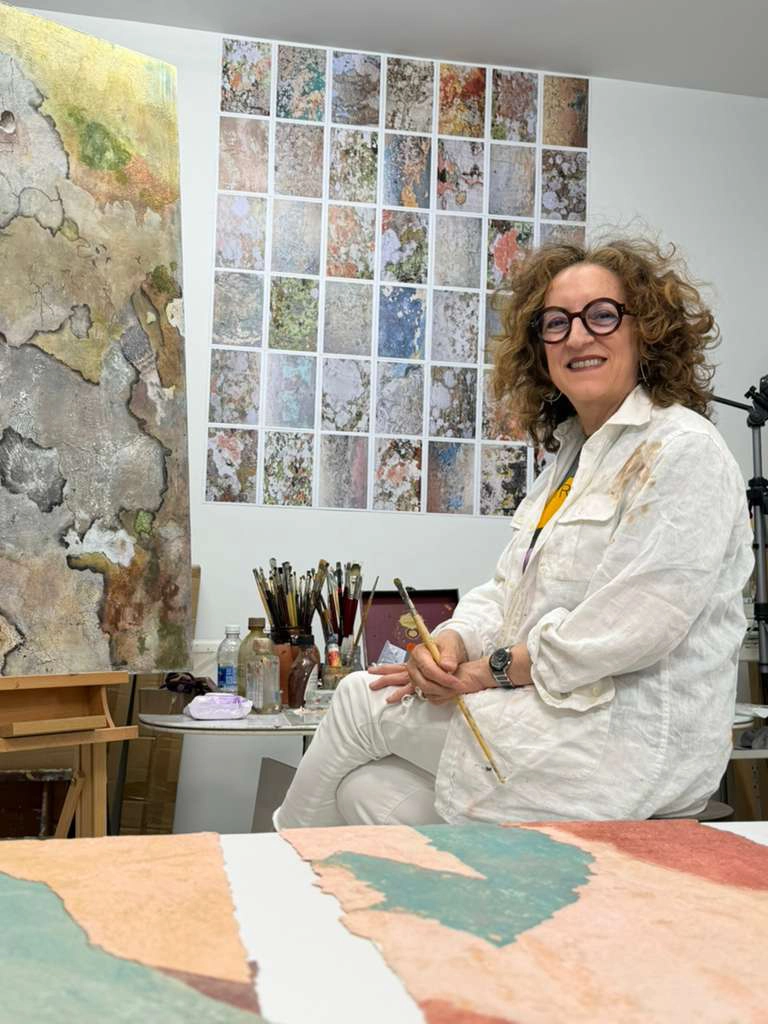
María José Escolar, a Spanish artist based in Washington, D.C., stands at a decisive moment in her professional trajectory as she prepares her upcoming exhibition at the Museum of Contemporary Art of the Americas (MoCAA) in Miami. This collaboration with one of Florida’s most significant contemporary art institutions marks a clear consolidation of her presence within the United States art scene. A surprise visit to her studio offered a rare glimpse into the process behind the series she is currently developing, a body of work poised to become the structural core of her Miami exhibition. What emerges is not merely a preview, but a confirmation of her ability to articulate a dialogue between European sensibility and American spaces of production.
In this new phase, Escolar’s aesthetic proposition unfolds through a sustained inquiry into the threshold between abstraction and a highly specific figurative referent rooted in nature. As the artist explains, her visual thinking originates in the observation of palm trunks overtaken by lichens, alongside deteriorating, flaking columns that share a common language of erosion. Her aim is to construct “small worlds,” or “islets,” within the pictorial field, translating organic textures and weathered materials into abstract structures charged with poetic intensity. Through this operation, elements drawn from both the natural and built environment acquire a renewed presence under her hand, displaced from their origin and rearticulated as visual thought.
Her creative process is marked by a radical openness to experimentation. The beginning of a series functions as an entry point into uncertainty rather than a predefined trajectory. Escolar understands her work as an evolving system capable of drifting toward unforeseen resolutions, moving between abstraction and figuration according to the demands of the experiment itself. This state of search, which she identifies as the most compelling dimension of initiating a new body of work, ensures that the outcome retains a condition of vitality. The promise of a subsequent studio visit before the exhibition only reinforces the sense that her work remains in motion, offering the viewer access to a constellation of self-contained and compelling “microworlds.”
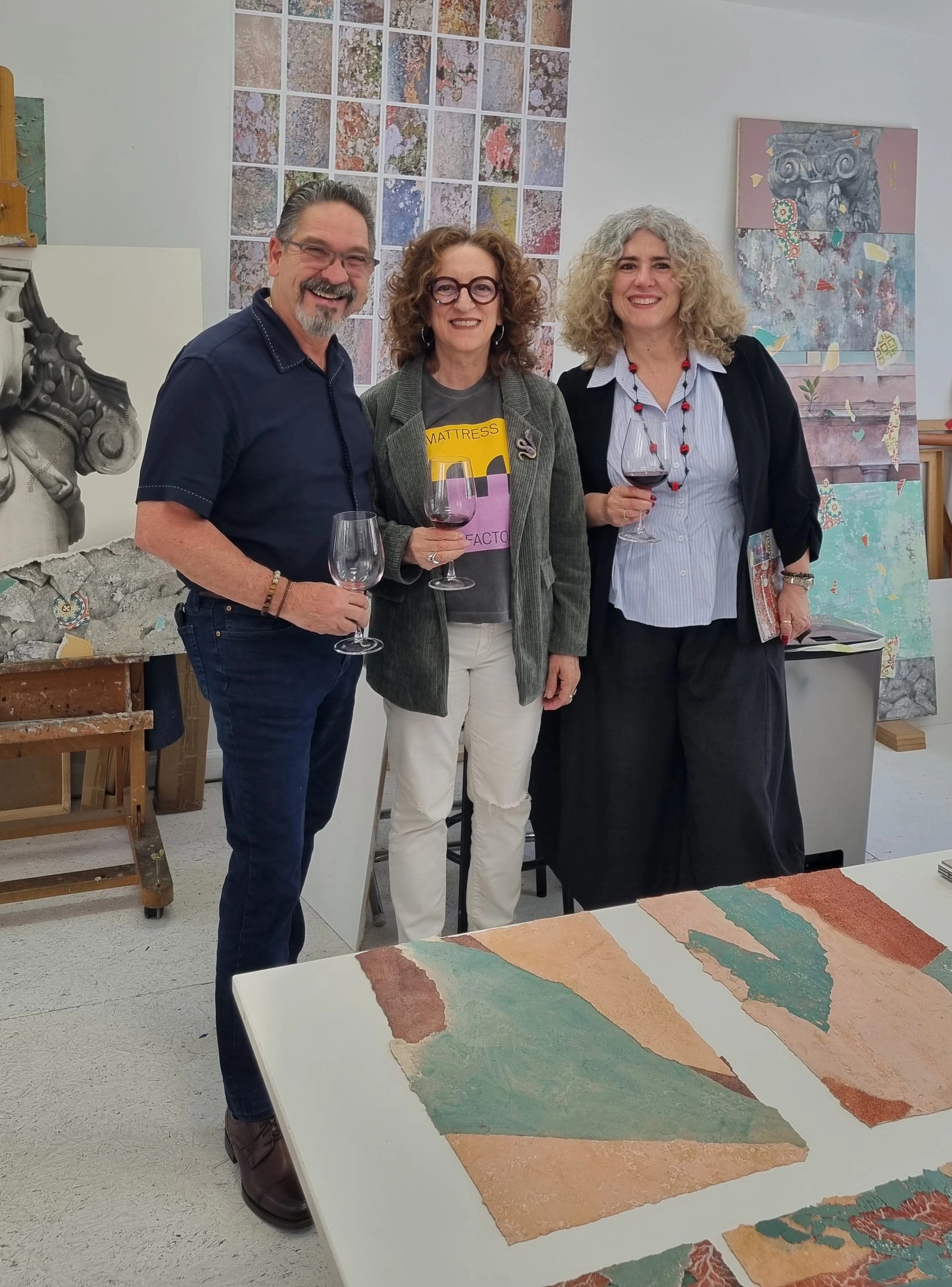
Over the past two years, MoCAA has positioned itself as a strategic agent of cultural cooperation. Its programmatic vision draws on Hispanic roots not as a fixed identity marker, but as a platform for international dialogue that exceeds geographic boundaries. By incorporating into Florida’s artistic ecosystem poetics shaped in other latitudes—such as that of María José Escolar—the museum assumes a critical role in expanding the local imaginary beyond the dominant narratives of migration and diaspora. These initiatives invite Miami’s audiences to engage with aesthetic languages that, while sharing a cultural and linguistic matrix, articulate universal and conceptual concerns from distinct geopolitical positions. Within this framework, MoCAA operates as a bridge that enriches the local scene, advancing a more plural understanding of the Hispanic condition. Contemporary artistic production from the Iberian Peninsula introduces a particular clarity and conceptual maturity that both complements and diversifies the broader landscape of Hispanic art in the United States.
María José Escolar (Palencia, Spain, 1964) is a visual artist whose trajectory has been shaped by a distinctly international life and professional experience. She earned her degree in Fine Arts from the University of Salamanca (1983–1988) and pursued postgraduate studies at the Rijksakademie van Beeldenden Kunsten in Amsterdam and at the Institut Wallon de Formation / IFAPME in Namur, Belgium. Over the past decades, she has lived in China, Morocco, Syria, Belgium, Gabon, the United Arab Emirates, and Cuba, an experience that has left a decisive mark on her multidisciplinary practice. She was a founding member and artistic director of The Art Circle in Abu Dhabi. She currently resides in Washington, D.C. Her exhibitions include correspondencias (2025), Entredós de La Habana, at the Centro de Desarrollo de las Artes Visuales de La Habana (2024), and The Trip, presented at the Jameel Arts Center in Dubai (2021).

