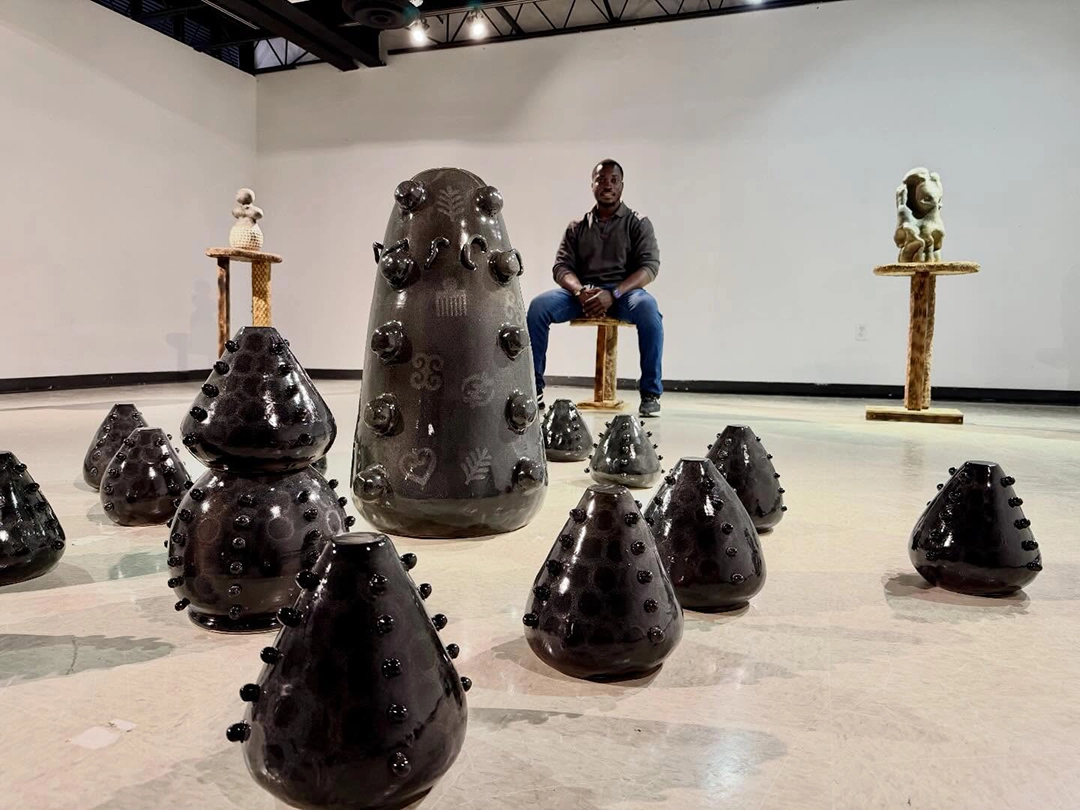
The artist Philip Tetteh Djorsu develops a practice that articulates memory, displacement, and belonging through a material investigation grounded in ceramics and installation. Originally from Ghana’s Eastern Region, his engagement with clay began at an early age, establishing a foundational relationship with a medium that, in his current work, expands into a conceptual language addressing migration and the construction of identity within contemporary contexts.
Since relocating to the United States, Djorsu has redirected his focus toward questions of movement, immigration, and the notion of home. His works operate as narrative structures in which symbolic elements tied to community, culture, and conditions of transit are brought into relation. Conceived as installations, his pieces unfold as open configurations where multiple components interact, generating spatial frameworks that evoke both intimate and collective dimensions of experience.
A central axis of his recent production revolves around the concept of “home,” understood not as a fixed location but as a condition continuously negotiated through movement. Through forms and imagery that reference communal life, Djorsu introduces motifs of family, shared culture, and social bonds, constructing a reading in which rootedness remains provisional. In parallel, other bodies of work engage the notion of “baggage” as a metaphor for the symbolic weight carried by the migrant subject, incorporating themes of aspiration, transition, and transformation.
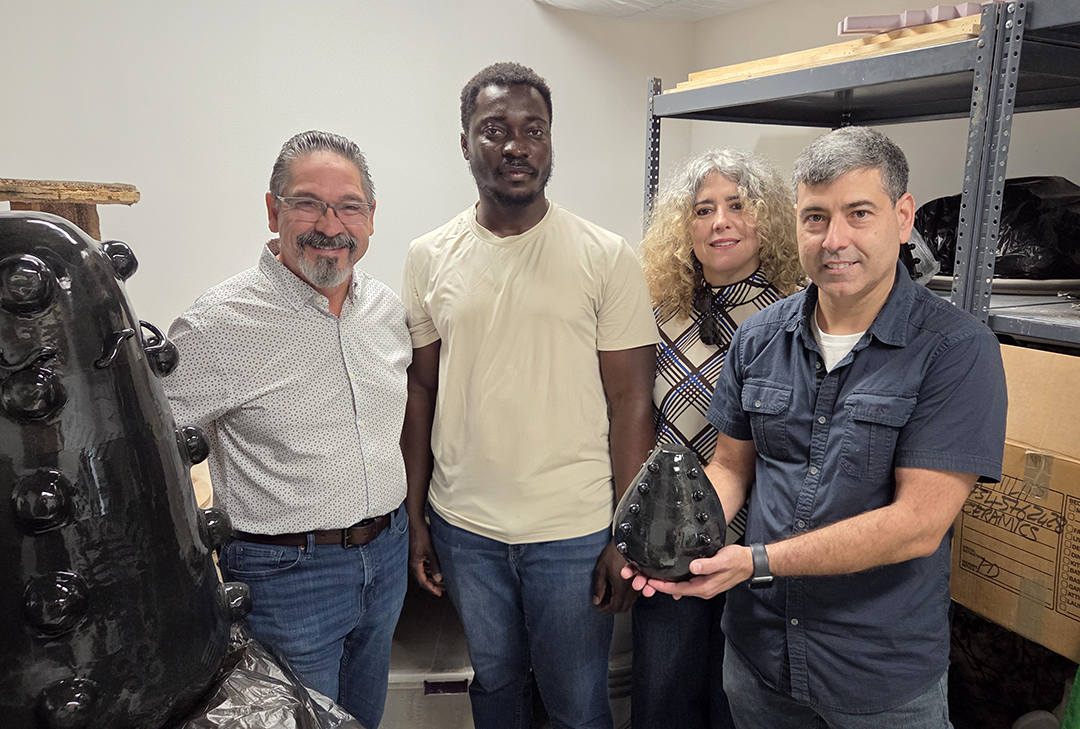
Within this context, the recent visit by a delegation from the Museum of Contemporary Art of the Americas to the studios at the University of Miami provided a direct encounter with his work. During the tour led by professor Carlos Enrique Prado, the museum’s representatives engaged with Djorsu’s installations in process, recognizing a sustained conceptual coherence and a capacity to translate personal experience into broader discursive frameworks. Such encounters form part of an institutional approach oriented toward identifying and supporting emerging practices at formative stages.
Within this context, the recent visit by a delegation from the Museum of Contemporary Art of the Americas to the studios at the University of Miami provided a direct encounter with his work. During the tour led by professor Carlos Enrique Prado, the museum’s representatives engaged with Djorsu’s installations in process, recognizing a sustained conceptual coherence and a capacity to translate personal experience into broader discursive frameworks. Such encounters form part of an institutional approach oriented toward identifying and supporting emerging practices at formative stages.
Djorsu’s inclusion within this framework affirms the relevance of his practice in relation to contemporary debates on identity, migration, and materiality. In line with its commitment to formative processes and the visibility of new generations, MoCA-Americas will continue to follow his work closely, understanding it as part of an expanding field in which individual experience is translated into formal structures capable of activating collective readings.