


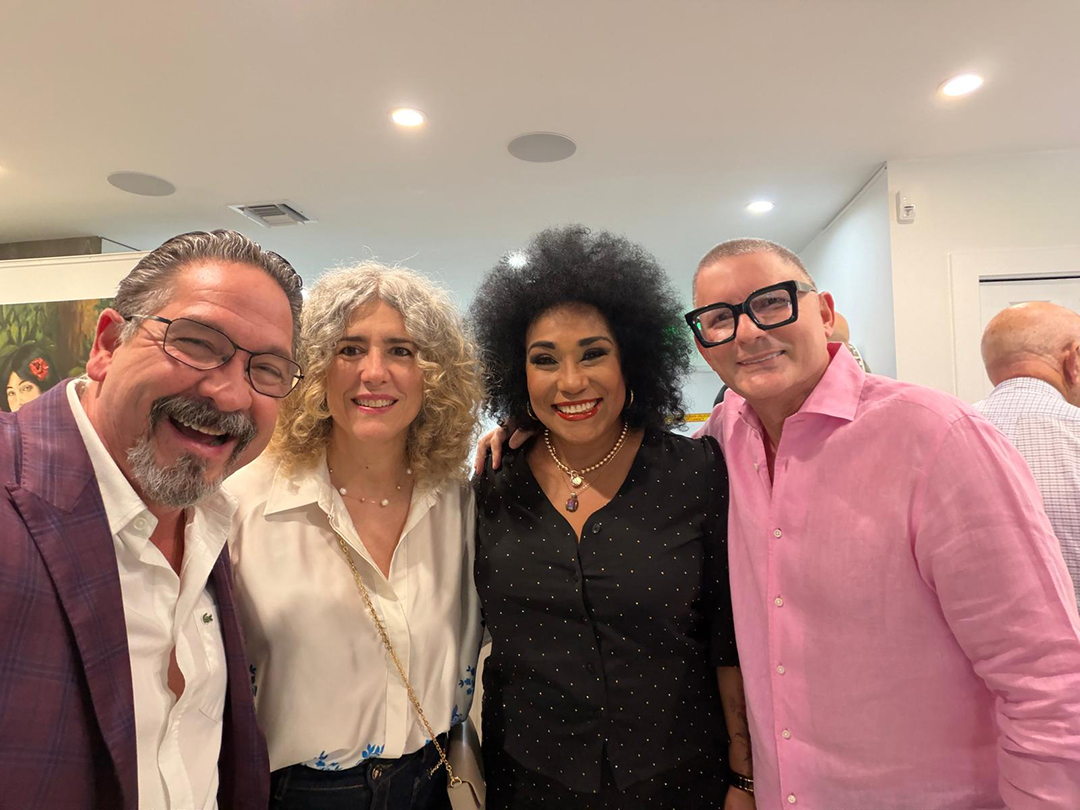
The presence of the Cuban singer, pianist, and composer—winner of one GRAMMY Award and two Latin GRAMMYs—added a singular resonance to the opening of Tony Rodríguez and Noel Dobarganes’s exhibition on Friday, June 26.
On Friday, June 26, the Museum of Contemporary Art of the Americas, MoCA-Americas, welcomed the celebrated Cuban artist Aymée Nuviola during the opening of Echoes of Humanity, an exhibition by painters Tony Rodríguez and Noel Dobarganes currently on view in the museum’s main hall.
The evening brought together a broad and diverse audience, including family members and friends of the artists, collectors, fellow artists, cultural workers, and art lovers from across South Florida. The opening was accompanied by a special musical intervention by guitarist and composer Ricardo González, conceived as part of the experience of moving through the exhibition and lingering with the works.
Within that setting, Nuviola’s visit carried particular significance. Her career has moved through some of the richest territories of contemporary Cuban culture, including popular dance music, timba, son, filin, bolero, and Latin jazz. Her artistic path reflects an understanding of tradition as a living force, one capable of moving across generations, formats, countries, and audiences without being reduced to a static form of nostalgia.
Internationally known as La Sonera del Mundo, Aymée Nuviola has built a career that brings together the force of tropical music with classical piano training and a vocal sensitivity that has also led her toward more intimate and complex repertoires. Her official biography identifies her as one of the foundational figures of timba and as the first woman to lead an internationally recognized band within that genre, a distinction that speaks to the singular place she occupies in a tradition historically dominated by male voices and leadership.
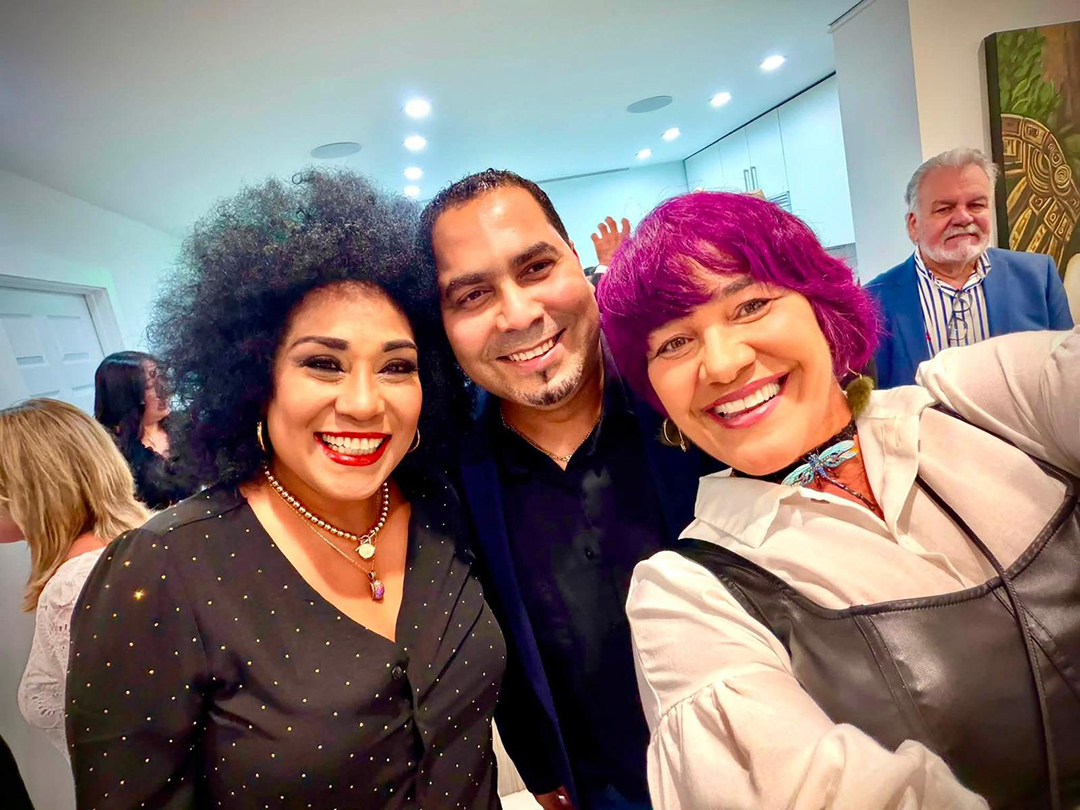
Her institutional recognition confirms the breadth of that trajectory. The Recording Academy credits Nuviola with one GRAMMY Award and four nominations. In 2020, she received the award for Best Tropical Latin Album for A Journey Through Cuban Music, a project deeply connected to Cuban repertoire, memory, and sound. The Academy also recognizes her nominations for First Class to Havana, Viento y Tiempo – Live at Blue Note Tokyo, recorded with pianist Gonzalo Rubalcaba, and Sin Salsa No Hay Paraíso.
The Latin Recording Academy, meanwhile, credits her with two Latin GRAMMY Awards and five nominations. Among those honors are the 2018 award for Como Anillo al Dedo in the category of Best Tropical Fusion Album, and the 2022 award for Gonzalo Rubalcaba and Aymée Nuviola Live in Marciac, recognized as Best Traditional Tropical Album. Her collaboration with Rubalcaba has occupied an important place in her recent work, opening a space in which her voice moves beyond the expansive orchestral format of tropical music and enters into a more direct dialogue with piano, improvisation, bolero, and jazz.
Nuviola’s career has also included a widely recognized audiovisual dimension. She was part of the principal cast of Celia, the television series inspired by the life of Celia Cruz, a production that brought the biography, legacy, and symbolic power of one of Cuban music’s defining voices back into the center of continental conversation.
Her presence at MoCA-Americas found a natural affinity with the spirit of Echoes of Humanity. The exhibition brings together Tony Rodríguez and Noel Dobarganes in the same space for the first time. Both artists arrive at painting from distinct visual languages and personal registers. Rodríguez, born in Santiago de Cuba, and Dobarganes, from Matanzas, share a sensibility shaped by human experience, memory, the body, inner tension, and the changing forms of identity. Each, however, develops a particular visual grammar, a different way of sustaining the figure and turning it into a field of reflection.
The visit of an artist such as Nuviola reinforced the atmosphere of exchange between artistic languages that defined the evening. Music and painting did not seek to illustrate one another, nor did they collapse into the same gesture. They coexisted within the same night as expressions shaped by a closely related cultural history while preserving their own rhythms, densities, and ways of approaching lived experience.
For MoCA-Americas, the opening once again affirmed the museum’s commitment to creating spaces in which contemporary art can meet the communities around it. Echoes of Humanity is part of the museum’s Art in the Community program, an initiative dedicated to expanding access to art, supporting artists connected to South Florida, and fostering encounters in which an exhibition does not function as an isolated event, but as a site of conversation and recognition.
Aymée Nuviola’s presence during the opening added an especially eloquent dimension to that evening. Her career has shown that Cuban music can remain in dialogue with tradition without becoming confined by it. It can be danceable, refined, popular, experimental, intimate, and expansive at once. In the main hall of MoCA-Americas, surrounded by the works of Rodríguez and Dobarganes, that trajectory became a close and meaningful presence within a night devoted to painting, community, and the many ways art preserves, transforms, and returns human experience to us.

