


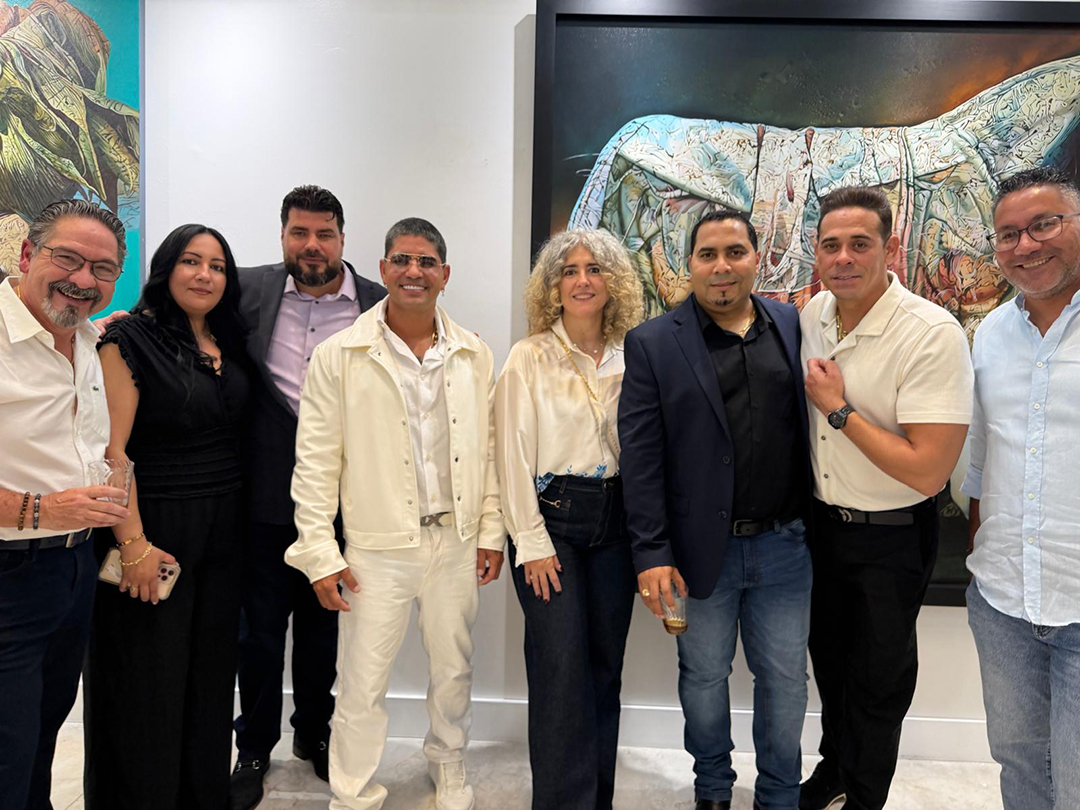
The Cuban singer, composer, arranger, and instrumentalist, known for his work with Clan 537 and for a career rooted in Cuban urban music, visited the exhibition by Tony Rodríguez and Noel Dobarganes at the Museum of Contemporary Art of the Americas.
Miami, FL — The Museum of Contemporary Art of the Americas recently welcomed Cuban musician Baby Lores during a visit to Echoes of Humanity, the two-person exhibition by Tony Rodríguez and Noel Dobarganes currently on view in the museum’s main hall.
Born Yoandys Lores González in Cienfuegos, Baby Lores began his musical formation as a teenager with the youth ensemble Ismaelillo. His early work as a guitarist, vocalist, bassist, pianist, and percussionist developed into a broader professional path as a composer, arranger, singer, instrumentalist, and producer.
In 2004, he became associated with Clan 537, alongside Leandro Medina, known as 1nsurrecto. The project became part of a defining period for Cuban reggaetón and urban music, reaching audiences in Cuba and across the diaspora. Songs such as “La Caperucita,” “Déjala Ir,” and “La Mujer del Pelotero” remain closely associated with that trajectory. After his work with Clan 537, Baby Lores continued through collaborations and solo projects that have kept him connected to successive generations of Cuban and Latin audiences.

His visit brought a figure from Cuban popular music into contact with an exhibition shaped by other languages of memory, transformation, displacement, and human persistence. On view from June 26 through July 17, Echoes of Humanity brings together, for the first time, the work of Juan Antonio Rodríguez Olivares—known as Tony Rodríguez—and Noel Dobarganes.
Rodríguez’s ongoing series The Weight of Wings considers the human body within systems of technological acceleration, adaptation, and uncertainty. Its mechanical wings, made of gears, metal feathers, and fragmented structures, appear as burdens carried by figures moving through unstable urban and emotional landscapes. Dobarganes, meanwhile, approaches the human through surfaces dense with color, texture, ornament, and gesture, where painting becomes a field of memory and accumulated experience.
The encounter with Baby Lores extended the exhibition beyond the visual arts. His trajectory belongs to a musical culture marked by circulation between Cuba, Miami, and a wider Latin American public sphere. In that movement, songs carry more than rhythm or entertainment: they retain voices, places, emotional codes, and collective memories that continue to change as they travel.
Such crossings are central to MoCAA’s cultural work. Through Musical Canvas, the museum creates spaces for musicians and artists working in music to share their work with audiences engaged with the visual arts. The program understands music as an artistic language capable of entering into dialogue with exhibitions, collections, and the wider cultural life of the institution.
Musical Canvas forms part of a broader MoCAA commitment to supporting artists and cultural workers beyond a single discipline. Through its programs, the museum provides platforms for musicians, students, emerging and mid-career artists, women artists, performers, authors, publishers, and editors. Its work is particularly connected to creators with Latin roots and to Cuban, Caribbean, Latin American, and diasporic artistic communities whose voices have not always received equal institutional visibility.
Baby Lores’s presence at Echoes of Humanity affirmed that larger field of exchange. Painting and music move through different materials, tempos, and publics, yet both preserve what communities carry with them across time and geography: images, rhythms, losses, desires, and forms of belonging that remain active long after their original moment has passed.
Echoes of Humanity remains on view at the Museum of Contemporary Art of the Americas through July 17.

