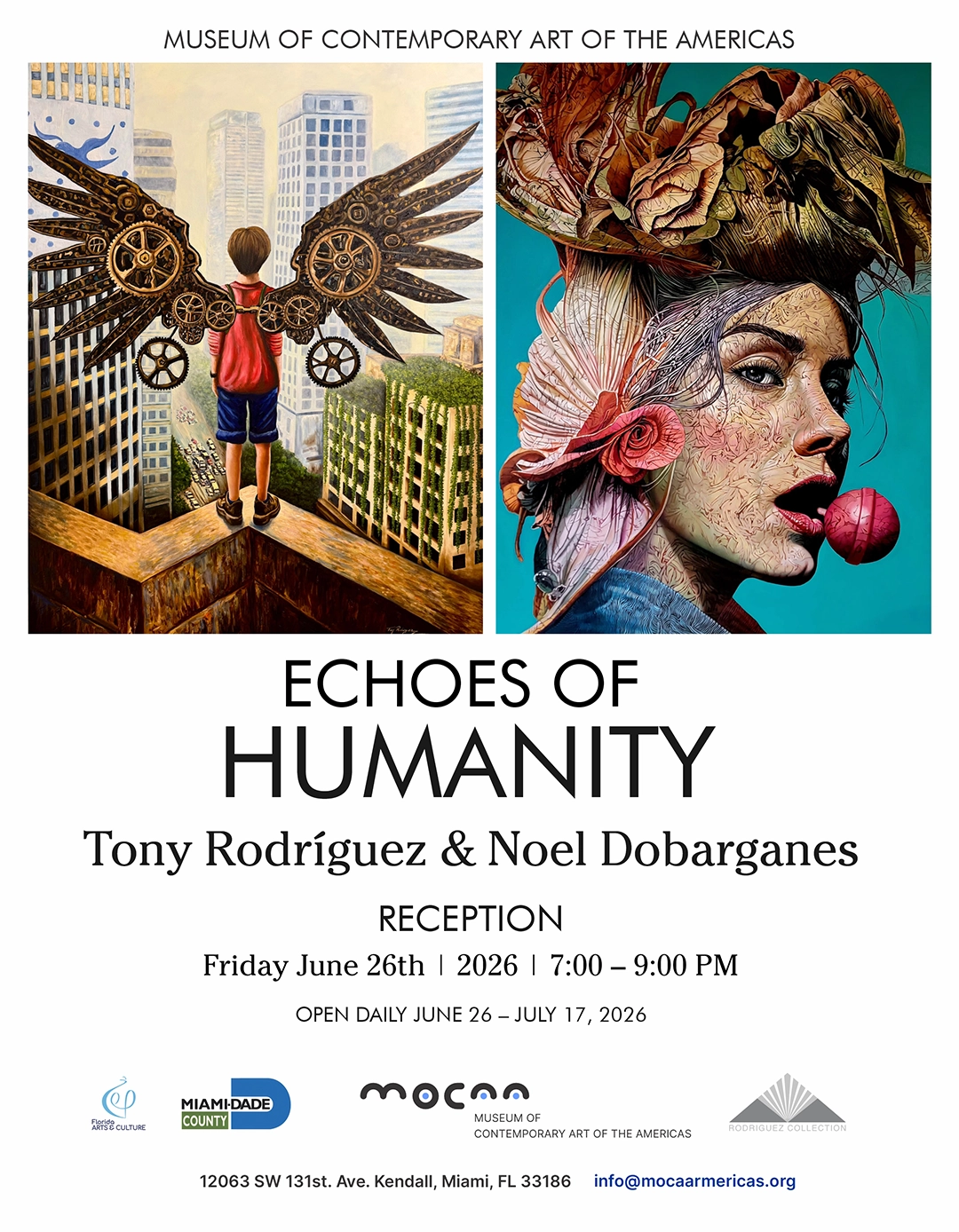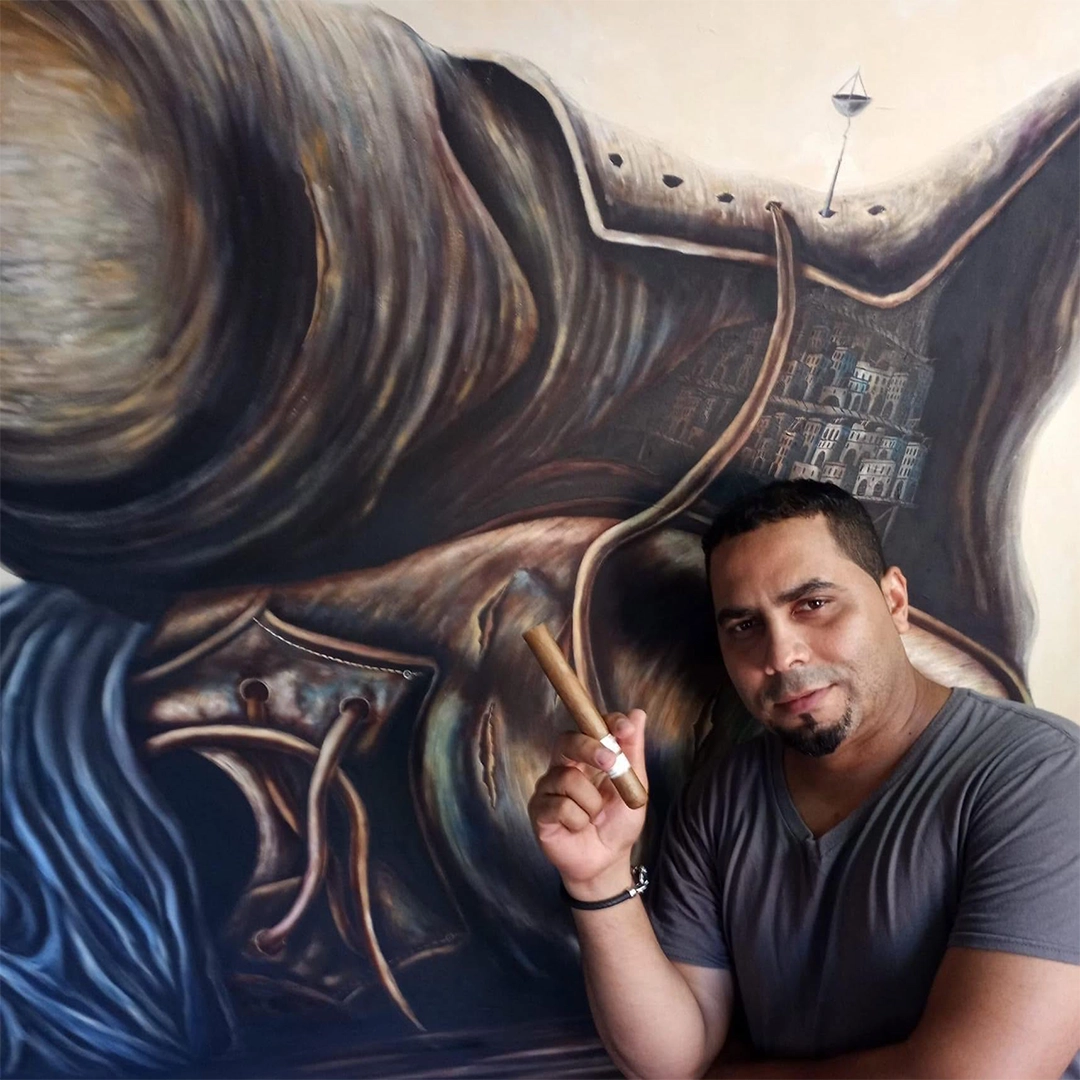
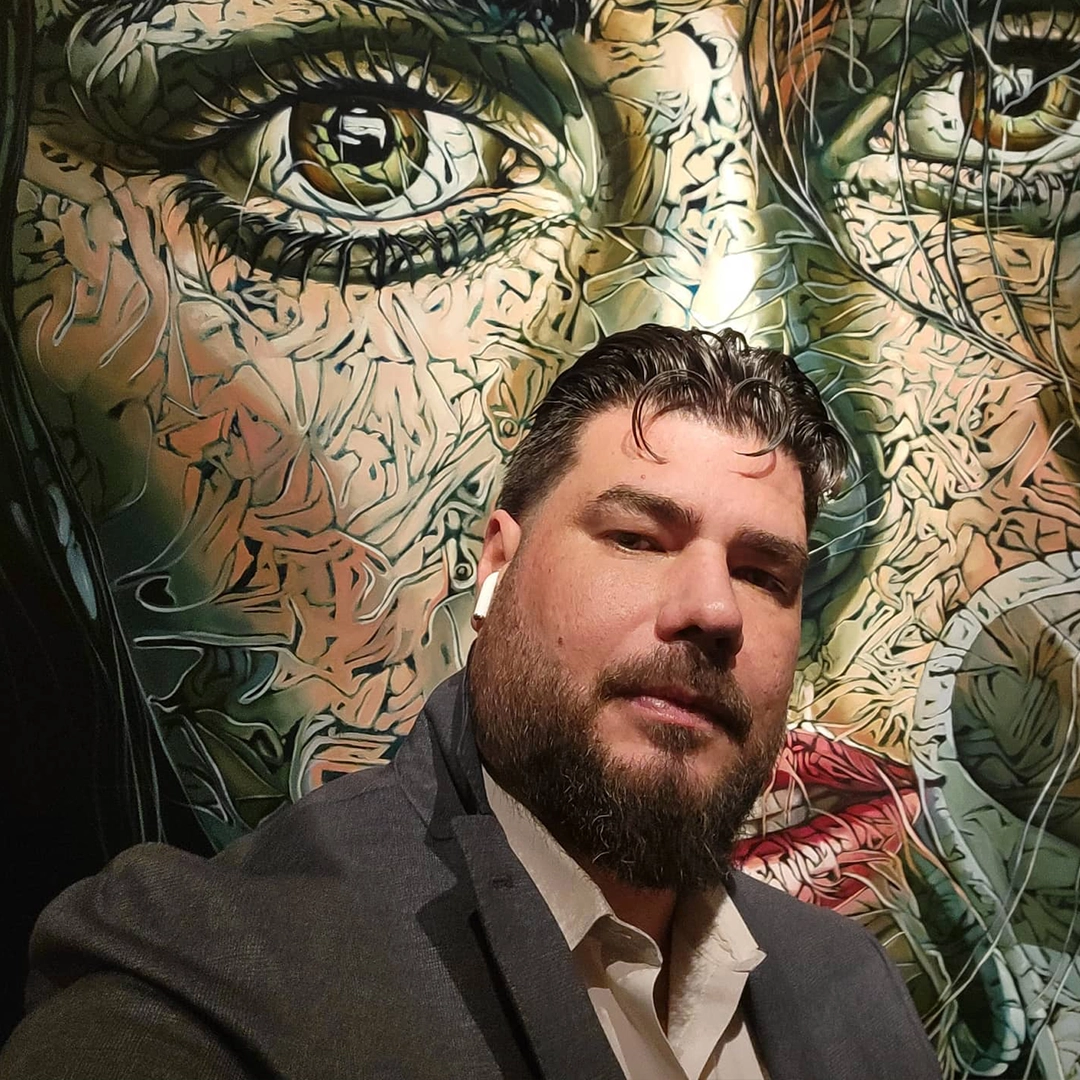
Two Cuban painters and one adoptive city. Juan Antonio Rodríguez Olivares — Tony Rodríguez — was born in Santiago de Cuba in 1980; Noel Dobarganes, in Matanzas, in 1977. Together they open a two-person exhibition in the main hall of the Museum of Contemporary Art of the Americas. The island's map separates them, the three years separate them, the road by which each came to painting separates them — Rodríguez out of Santiago's Generation 00, which turned eastern Cuban art toward Surrealism and the international visual conversation; Dobarganes out of a self-taught apprenticeship begun at seventeen and the Roberto Diago Professional School of Fine Arts. From June 26 to July 17, a hall of MoCAA brings them together. And something the shared biography cannot quite account for brings them together as well — a decision to work at the threshold where the figure loosens into painted surface and the painting, laden with matter, hints once more at a body.
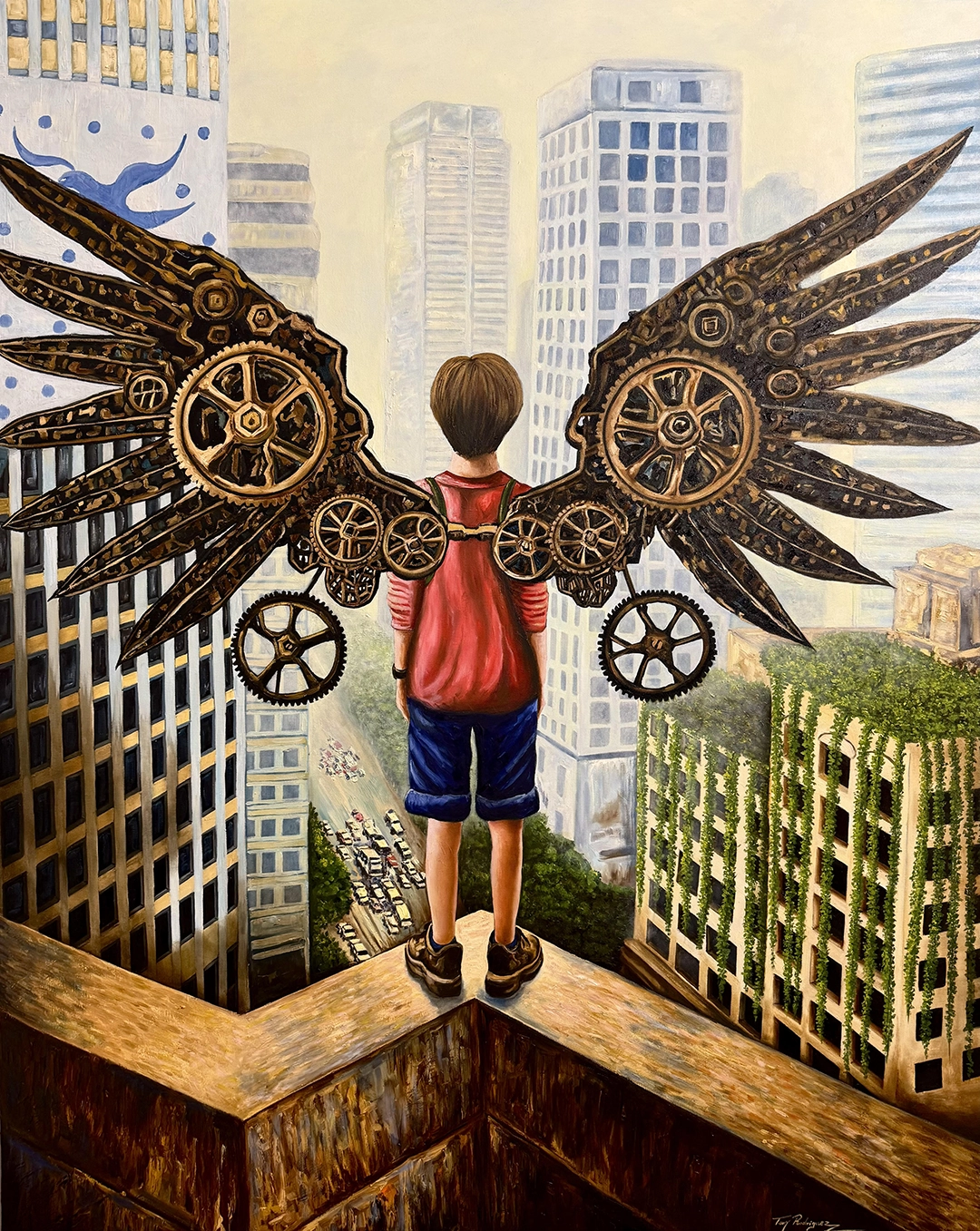
The series Tony Rodríguez presents, The Weight of Wings (oils on canvas, 2025 and ongoing), proceeds from an explicit hypothesis — the moment when biological and digital systems cease to be distinguishable as vectors of human transformation. Rodríguez paints the grammar of that rupture from within, with the very materials of the rupture. The mechanical wing organizes the series. Built from gears, metal feathers, and fragmented mechanisms, it is the formal discovery on which the rest depend. In the iconography of flight, from Icarus to the angels of the Baroque, the wing cancels gravity; on these canvases, the wing is gravity. It is the ballast the figures carry on their shoulders.
These wings function as external structures of memory, physical manifestations of the adaptive burden that bodies drag with them as they cross systems never designed for them. In an age when algorithmic architectures increasingly decide the margin of the possible, the handcrafted making of these forms introduces a deliberate friction — the insistence of the imperfect, the organic, the slow. The figures — children, women, bodies seen from behind — inhabit these settings without fully belonging to them. Their anonymity displaces identity without denying it; they are subject-positions more than subjects, and they bear the weight of invisible systems while registering the persistent, irrational will to go on. The city runs through the series as a structure that advances and dissolves at once — architecture that no longer holds what it ought to hold — and nature survives at the margins, fragile, residual.
What Rodríguez paints is the phenomenology of living inside accelerating systems — the texture of a consciousness pressed by forces with no face, no center, and no off switch. Technically, the series crosses realism with symbolic construction and draws on Surrealism to move toward a more personal language, made of hybridity, introspection, and contemporary anxiety. The mechanical forms are worked by hand, with no digital inflection, to underscore the imperfect, emotional dimension of human evolution — the persistence of the hand's mark at the precise moment obsolescence most threatens it.
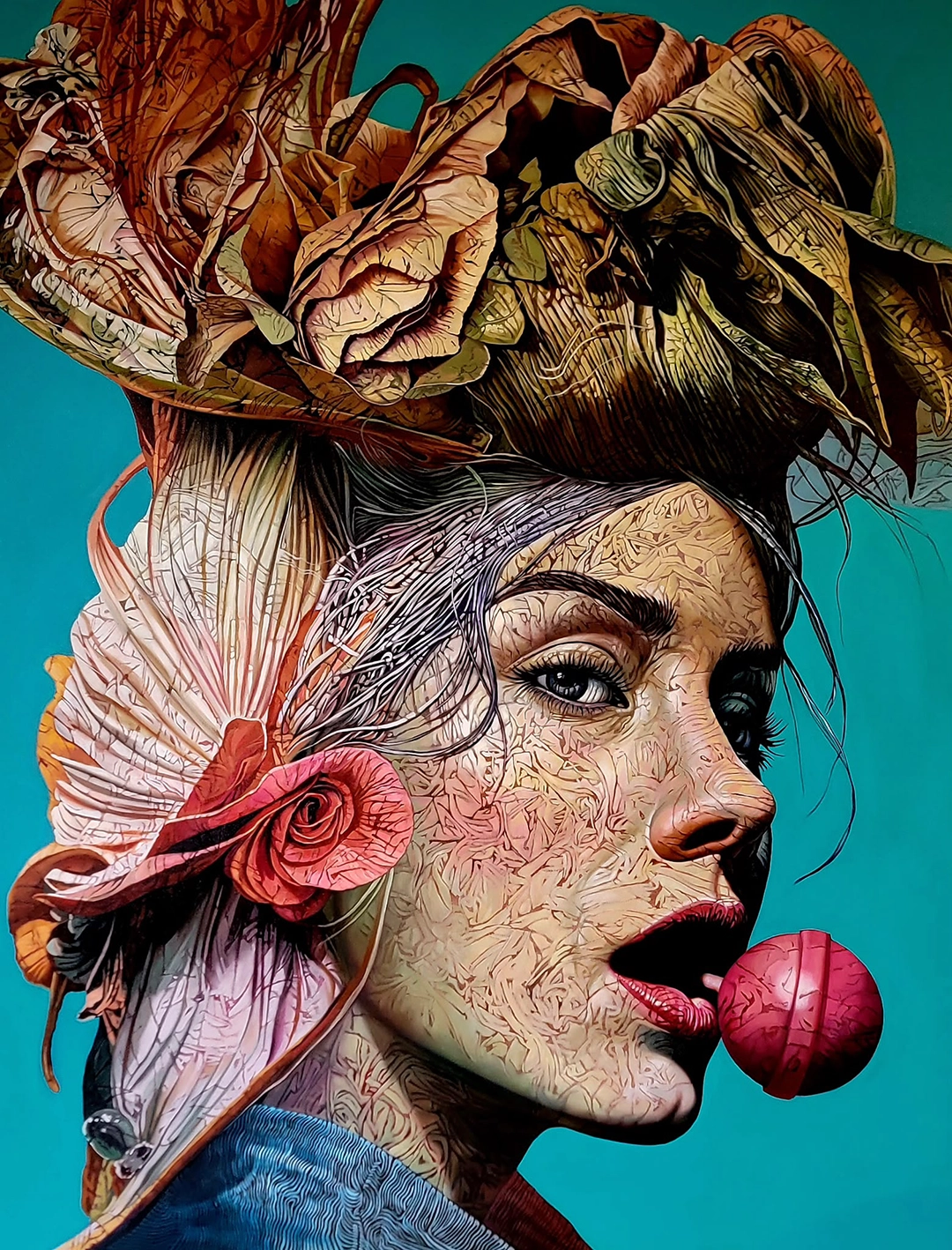
Noel Dobarganes reaches that same border between figuration and abstraction by another road. His painting turns on time and memory, and on an intense exploration of color, of area, of line, of texture, of ornament. His own website describes charged surfaces, at moments close to horror vacui, where textures — real or virtual — hold the center and call for contact, visual and tactile. Criticism has read in that painting a fluid coexistence of abstraction and figuration. Píter Ortega describes him as a versatile creator, able to move among the rural landscape, the animal representation, the human face, and the female nude, with dynamic compositions, strong chromatic contrasts, and a complex relation between figure and ground. Fernando Castro Flórez, in Artepoli, notes that Dobarganes overflows the conventional separation between the abstract and the figurative, working portraits, landscapes, chromatic expansions, and countenances in a single gesture.
Andrés Isaac Santana, in Arte al Límite, presents him as a Cuban artist living in Miami and reads his painting through a baroque condition — obsessive, indifferent to certain mechanisms of canonical legitimation. Jorge Peré, in Artepoli, insists on that baroque quality, on the blend of realist figuration and expressionist drive, and on time as one of the central matters of his poetics. When I stop before one of those surfaces, I see deposited time — layers of color, texture, and ornament that accumulate until the ground stops being ground and begins to weigh as matter. Horror vacui works here as a form of memory; the surface refuses to forget, holding every gesture, every layer, every chromatic decision, and forcing the eye to travel it with no point of rest. Hence the baroque that Santana and Peré point to, understood as a temperature of the gaze and a sustained pressure on every inch of the canvas.
Brought together in the same hall, Rodríguez and Dobarganes make plain what each pursues on his own — weight. In Rodríguez, weight is an apparatus, the gear-wing the figure holds on its back; in Dobarganes, weight is the surface itself, time sedimented in layers that ask to be touched. Neither one resolves the tension he builds. Rodríguez sustains the disequilibrium between the organic and the mechanical, between the utopian impulse and the weight of its impossibility; Dobarganes holds in suspense the border between figure and ground, between what is recognized and what dissolves. And both keep the human figure inside the picture, present and estranged, with no narrative alibi to explain it.
When you cross the hall — from the figures Rodríguez burdens with wings of gears to the surfaces where Dobarganes lets time settle — the painting insists on the same thing from its two shores: the wing the back sustains, the layer the eye never finishes traveling. Two ways of going on weighing in the hall long after you have gone.