


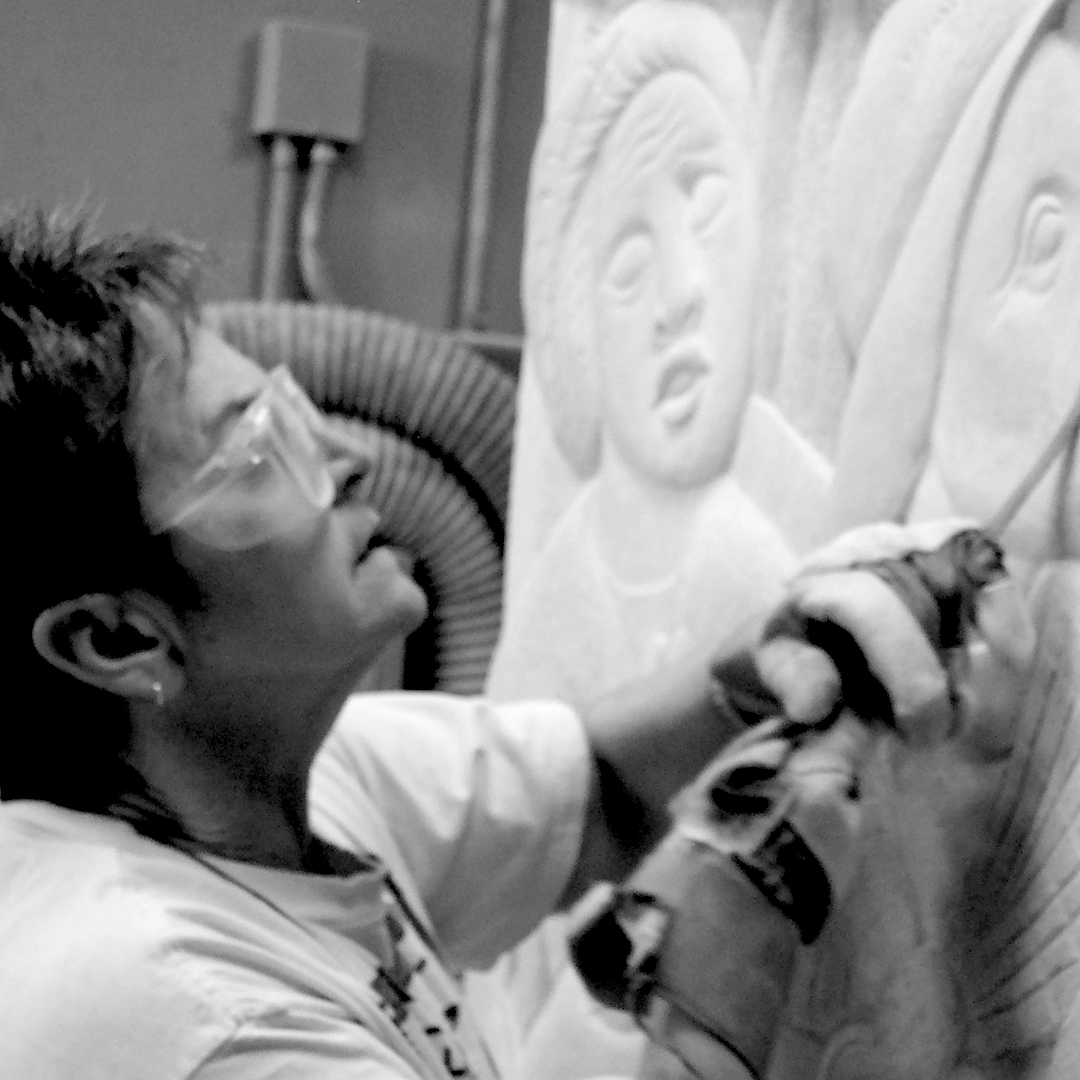
Throughout this week, we will be publishing brief features on the women artists whose works are included in the exhibition Women of PAC. Each of them maintains a studio practice within the Pendleton Art Center (PAC) complex. Today, we begin with artist Karen Heyl.
Karen Heyl presents herself, above all, as a sculptor. That definition organizes her trajectory and clarifies the meaning of her work. Her practice arises from carving, relief, and a sustained relationship with materials marked by weight, permanence, and resistance. From that ground, her ventures into clay, color, and the avian forms that now occupy an important place in her work also become legible.
For years, her name has been closely associated with relief sculpture carved in limestone. On her website, this is described as the work for which she is best known: a language of simplified yet sensual figurative forms, textured surfaces, and a contemporary sensibility that often retains a narrative impulse. Limestone itself is described there as a material of natural beauty, strength, and permanence, capable of sustaining an enduring visual memory. Textures and carved lines introduce into these works a sense of power and movement that remains central to her production.
That sculptural background also extended into public space. In the conversation included in the material, Heyl recalls that she is locally known for her relief carvings and mentions a fifty-foot wall in a church that tells the story of Creation. She also speaks of major commissions and public art projects carried out in Colorado, California, Florida, Minnesota, and other areas along the East Coast. Her visual formation, then, took shape in direct contact with architecture, commission, monumental scale, and the public presence of sculpture.
Within that trajectory, the economic crisis of 2008 marked a turning point. As she herself explains, when everything collapsed for her because of the economy, she decided to learn clay. Between 2010 and 2011, she began making her first clay vessels and discovered in the process a new possibility: works she could lift, handle, and physically engage in a different way. Clay opened up a field that was more immediate and manageable, yet her history as a stone carver remained present from the outset.
Heyl states it plainly: she felt the need to remain faithful to her training in carving. That is why many of her ceramic works incorporate limestone bases, and why her move into clay did not mean leaving stone behind, but rather expanding her vocabulary. In her hands, both materials come together within a single sculptural logic. The continuity between weight and lightness, between stony support and modeled form, has become one of the keys to her recent poetics.
Another decisive aspect of her work is the way she treats the surface. Many of her ceramic pieces are not glazed: they are painted with acrylic and worked with colored pencil. The phrase with which she explains this has the force of a statement of principle: “it’s my work, I can do whatever I want.” In that position there is technical freedom and personal authority. Heyl does not subordinate the work to any orthodoxy of medium. She constructs it according to what the piece requires. Later she formulates this even more precisely: she does not consider herself a ceramist, but a multimedia sculptor.
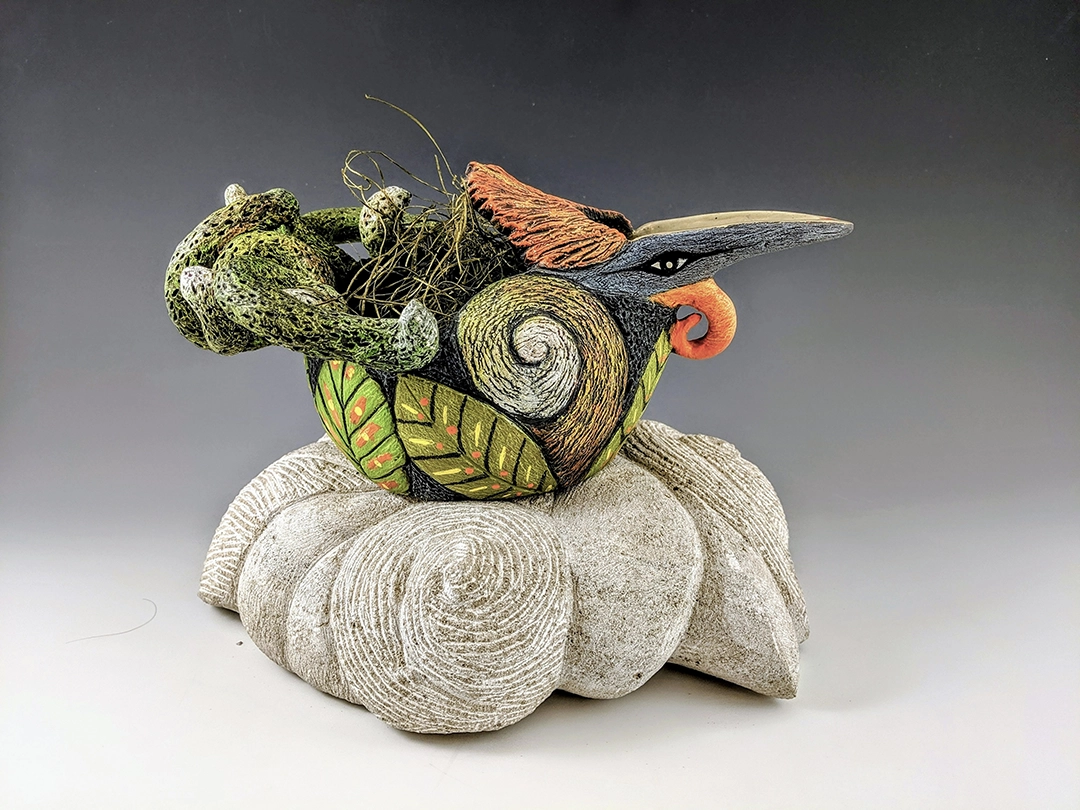
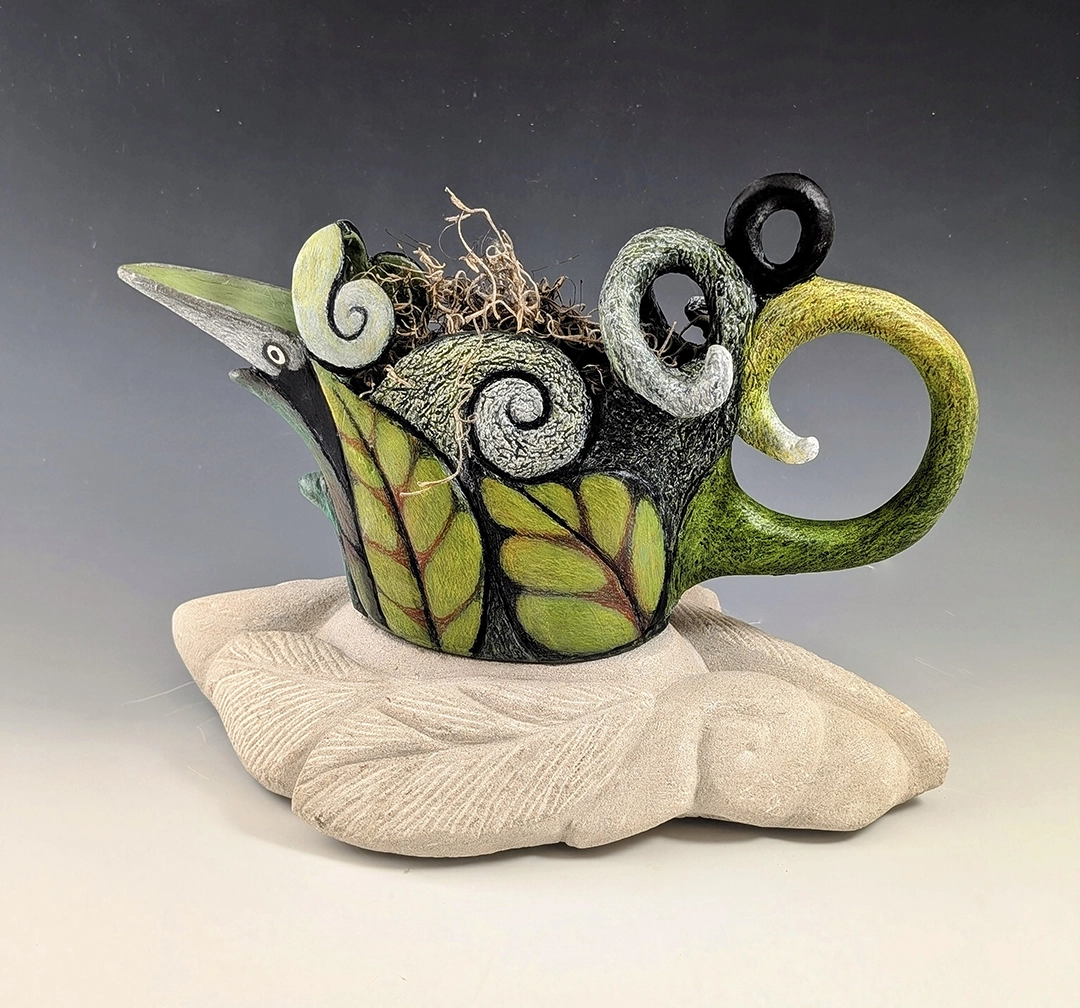
Among the most recognizable lines of her work are her bird-vessels, mixed-media ceramic sculptures that combine carving, color, and limestone bases. On her website they are described as unique mixed-media pieces, and visitors are even invited to come to her studio at the Pendleton Art Center to choose one. In the conversation, the artist explains how they came about: she began with a vessel form resembling a pitcher for pouring water and, as she worked on it, realized that it looked like a bird. From that association, she decided to transform those pitchers into birds. Each one is different, and some incorporate elements that evoke nesting materials.
The origin of these pieces matters because it reveals a formal imagination that discovers relationships within the material itself. In Heyl’s work, form does not always arrive from a prior program; it emerges from a visual intuition that becomes structure. The vessel becomes a bird; function shifts toward a living image; the work preserves something of the act of containing and adds to it an idea of growth, shelter, and movement. According to the artist herself, she has sold around sixty-five of these birds over the years, a sign that this is not an isolated occurrence but a body of work already firmly established.
At this moment, however, her work seems to be undergoing a new expansion. Heyl says she began asking herself what else she could do and recently started producing carved and painted plaques, developed only within the past couple of months. These pieces relate directly to her earlier relief practice and, at the same time, respond to a concrete consideration: offering more affordable works to people interested in her art but without the budget or space for larger sculptures. The observation with which she sums it up is simple and sharp: everyone seems to have wall space.
Material, in any case, remains central. In her studio one finds limestone, alabaster, soapstone, and marble from the state of Georgia, along with other stones from various places. Heyl does not turn that diversity into geological discourse, but she does convey a concrete familiarity with materials and with their visual and physical qualities. She also recalls that her introduction to stone carving took place at the Art Academy alongside Walter Drysdale, whom she identifies as a decisive figure in that learning process. That genealogy confirms once again that the heart of her work lies in sculpture.
Her relationship to ceramics is defined precisely through that awareness. She herself says that she does not have enough years left in life to learn everything about ceramics, and she mentions glazing as a terrain too chemical and too alien to her patience. The phrase does not sound like a limitation, but a choice. Heyl works through a mixture of clay, stone, paint, colored pencil, relief, and carving. Her work affirms itself in that hybridity, in that freedom to cross procedures without asking permission from any closed discipline.
There is, moreover, a symbolic dimension that appears with particular clarity in the most recent pieces. In the dialogue, Heyl mentions a work connected to “the wonders of nature,” drawing from a hornet’s nest, and another in which she speaks of growth and the release of the spirit. She explains that on the reverse there is a bird over a female form, and that the piece is precisely about releasing the inner spirit. Nature, bird, growth, and the human figure compose here a field of associations that introduces a spiritual layer into her material language.
It is also revealing that these works are still in process, drying, and that the artist speaks of the sleeplessness they produce in her. She says she cannot sleep at night thinking about them, wondering what to do, how to transform them, how to bring them to resolution. That moment of creative unrest makes visible an artist still searching, driven by the work itself and by the need to discover how far her language can continue to grow.
Taken as a whole, Karen Heyl’s trajectory reveals a practice sustained by sculpture and expanded through adaptation, invention, and the crossing of materials. From relief carving in limestone to bird-vessels, from monumental public work to recent wall plaques, her work maintains a constant fidelity to form, volume, and the physical experience of matter. Her imagination moves freely among stone, clay, color, and symbol, finding in each intersection a new possibility of meaning.
Karen Heyl has thus built a body of work in which carving remains alive even when the support changes. Her sculptures, reliefs, and mixed-media pieces speak of permanence, transformation, and an ongoing attentiveness to the relationship between material, image, and viewer. In them, matter retains memory, color introduces a new energy, and form continues to open itself toward other possible states.
Images in Sequential Order
Photograph of the artist
From the Avian Vessels Series: Nesting, undated
Mixed media, clay, limestone, acrylic and various organic materials
From the Avian Vessels Series: Spring, undated
Mixed media, clay, limestone, acrylic and various organic materials

