


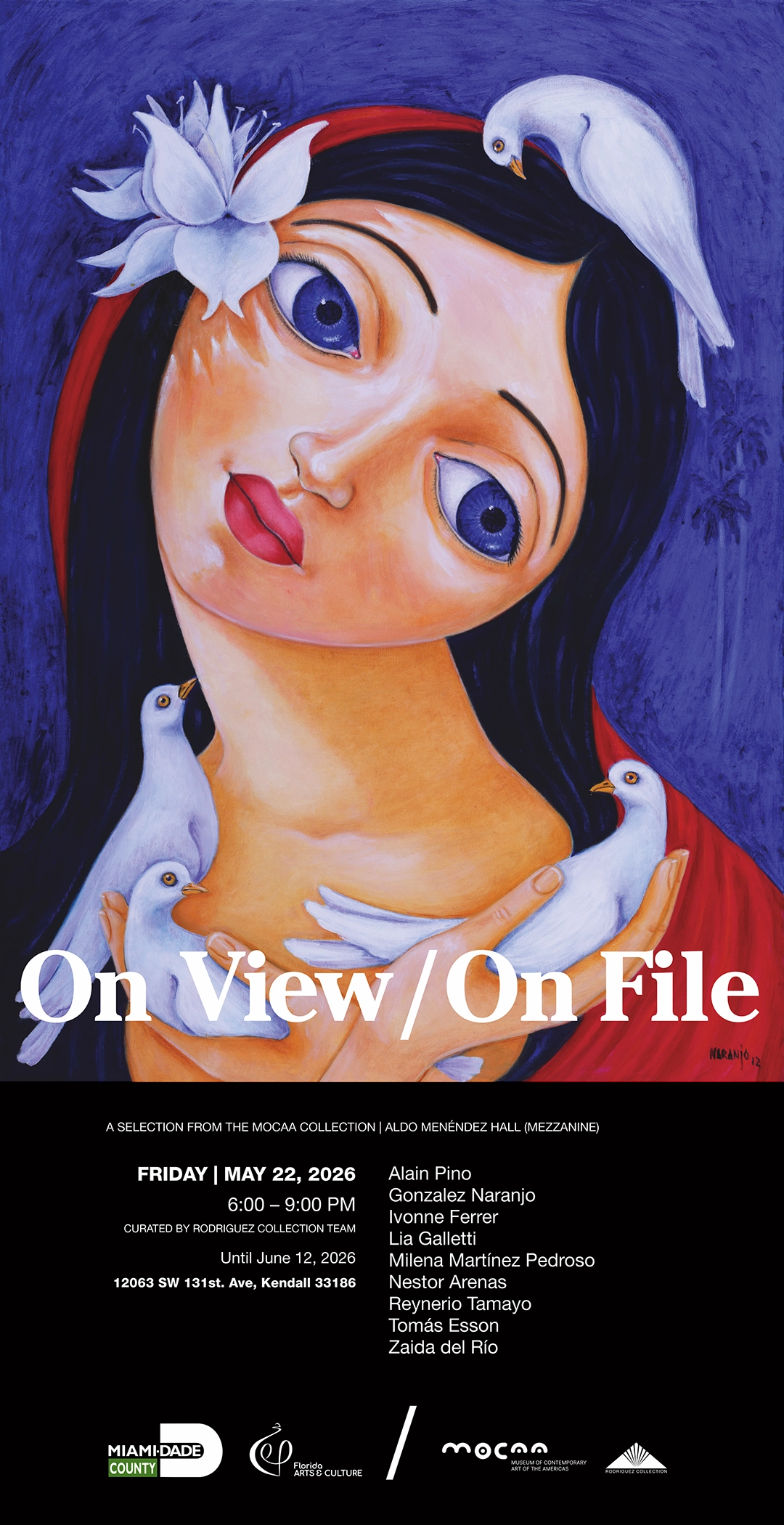
Some works in a museum's collection live a permanent life on view. Others rest on file —documented, conserved, awaiting the right moment to return to the wall. On View, On File opens that second life. The exhibition gathers a selection of works from the MoCAA Collection that, for a season, leave the archive to occupy the museum's Mezzanine Gallery, in dialogue with the main exhibition below.
The selection is not a survey. It is a deliberate revisiting. Each piece has been chosen because it belongs to an ongoing conversation between MoCAA and the artists who have accompanied the institution across years —in some cases, across more than a decade. Many of these are names the South Florida community has met before, in earlier exhibitions of the Kendall Art Center and, later, of the museum itself. To bring their works back into view is to honor that continuity, and to remind both the audience and the artists themselves that the collection is not a static repository but a living archive that the museum is committed to circulating, studying, and sharing.
This exhibition belongs to a broader institutional understanding of what a museum collection is for. The MoCAA Collection has always been envisioned as a space for research, inquiry, education, and community enjoyment —a vital component of the museum's program, not a sealed treasury. On View, On File operationalizes that idea. It opens a sustained channel through which works in storage can return to the public, and through which artists who have shaped the museum's identity can see their work re-presented in conversation with the current curatorial moment.
A timely note accompanies this edition. While On View, On File is on view, the documentary Naranjo, by filmmaker Jorge Soliño —dedicated to the life and work of Cuban painter Orlando González Naranjo, whose work is included in this presentation— premieres on May 22 at the Koubek Center as part of Miami Dade College's Cuban cinema series. The coincidence is no accident: the museum and the city's cultural circuit speak to each other, and a piece from the collection can find renewed visibility precisely when a parallel platform brings its author into focus. This kind of resonance is what the Aldo Menéndez Hall is for.
There is also a social commitment at the heart of this project. MoCAA serves the diverse communities of South Florida and the Americas, and it does so by understanding that the relationships built around art —with artists, with audiences, with collectors, with the neighborhood— are themselves part of the work the museum produces. By returning these pieces to the wall, the museum reaffirms its long-standing alliances with the artists of the house, with the families that have followed its programming since the days of KAC, and with the new visitors discovering, for the first time, that what they are looking at has a history within these walls.
On View, On File will be updated periodically. New selections will follow, attentive to the dialogues each main exhibition opens. The Mezzanine, in this sense, becomes a second voice —discreet, attentive, and faithful— that keeps the collection breathing alongside the museum's central program.
Featured artists
Alain Pino (Camagüey, Cuba, 1974). Multidisciplinary visual artist trained at the Instituto Superior de Arte in Havana. Co-founder of the artist collective The Merger, alongside Niels Moleiro and Mario Miguel González (Mayito), with whom he worked for nearly a decade. His current practice navigates the intersections of technology, design, and image-making through photography, painting, and installation. He has lived and worked in Miami since 2015. 1stdibsMocaamericas
Ivonne Ferrer (Havana, Cuba, 1968). Painter, printmaker, and ceramist. Graduate of the San Alejandro Academy of Fine Arts and the René Portocarrero National Silk-Screen Printing Workshop in Havana. After exhibiting in Spain and Denmark in the early nineties, she emigrated to the United States in 1995 and built a major career between painting, sculpture, public art, and screen printing. She co-founded the Fine Arts Ceramic Center with collector Leonardo Rodríguez during the pandemic, and currently serves as Vice-Director of MoCAA. Ivonne FerrerCanvasrebel
Lia Galletti (Havana, Cuba, 1943). An established painter and printmaker known for her work in abstract expressionism. She moved to New York City in 1960 at the age of 17, where she completed her education and began to paint and exhibit in Greenwich Village and other venues along the East Coast. Based in Miami, she has maintained an active studio practice for over six decades. She has generously donated to MoCAA the surviving copies of the historic Genesis III portfolio, a collective project of thirty Cuban exile artists from the early nineties. MocaamericasMocaamericas
Milena Martínez Pedrosa (Cuba). Visual artist with an extensive career spanning drawing, painting, and performance, who has more recently redirected her creative focus toward ceramic arts and installation. Her three-dimensional pieces, often built through the multiplication of recurring motifs, take the form of self-conceived altars that reflect on individuality, inhabited space, and the boundaries of freedom. MoCAA produced and curated her recent solo exhibition Mud, Fire, and the Alchemy of Faith at Miami International Fine Arts. Mocaamericas
Nestor Arenas (Holguín, Cuba, 1964). Contemporary visual artist and photographer. Graduated from the Higher Institute of Art in Havana in 1990, he has widely exhibited his work in solo and group exhibitions throughout the United States, Cuba, Spain, and China. Recent participations include the 12th Havana Biennial (2015), Lyle O'Reilly Gallery in Miami, and the Shanghai Art Fair. His work is held in private and institutional collections in Miami, New York, Sarasota, Pennsylvania, and Valencia, Spain. kendallartcenterkendallartcenter
Orlando González Naranjo (Cuba). Painter who emigrated to the United States in 1984. His work —imbued with nostalgia, color, and pain— operates as a refuge where the faces of the lost land emerge: peasant women with large unfathomable eyes, rural landscapes, national symbols, and deeply expressive faces. He has shared exhibition spaces with renowned masters such as Wifredo Lam, Amelia Peláez, Mario Carreño, and Gina Pellón. His paintings are held in private collections in Spain, the United States, Poland, and Venezuela. The documentary Naranjo, by Jorge Soliño, dedicated to his life and work, premieres on May 22, 2026, at the Koubek Center as part of Miami Dade College's Cuban cinema series. Diario Las Americas + 3
Reynerio Tamayo (Niquero, Cuba, 1968). Visual artist graduated from the Escuela Nacional de Artes Plásticas (ENAP) in 1987 and the Instituto Superior de Arte de la Habana (ISA) in 1992. One of the most prominent voices of the so-called nineties generation in Cuban art, recognized for a body of work in which irony and sarcasm operate as critical strategies. His work is held in numerous public and private collections, including the National Museum of Fine Arts in Cuba, the Van Reekum Museum in the Netherlands, the Gilbert Brownstone Collection in France, the Howard Farber Collection in the United States, and the Benicio del Toro Collection in Puerto Rico. MocaamericasMocaamericas
Tomás Esson (Havana, Cuba, 1963). One of the major voices of the eighties generation in Cuban art. From his very first exhibition in Havana in 1988, which was censored and closed by Cuban authorities, Esson developed a major body of expressionist paintings, emerging as one of the most dynamic voices of the Afro-Caribbean diaspora. He left Cuba in 1990 and has lived and worked between Miami and New York since then. In 2020–21 he was the subject of a thirty-year career retrospective, The GOAT, at the Institute of Contemporary Art, Miami. OculaOcula
Zaida del Río (Guadalupe, Las Villas, Cuba, 1954). Painter, draftswoman, printmaker, ceramist, and performance artist. Trained at the Provincial School of Visual Arts in Cienfuegos, the National School of Art in Havana, the Higher Institute of Art in Havana, and the École des Beaux-Arts in Paris. One of Cuba's most respected living female artists today, her work draws on magical realism, Afro-Cuban iconography, and a deep dialogue between femininity and nature, weaving anthropomorphized beings, plants, and animals into a personal cosmology. Cuban Art DatabaseMLA Gallery

