


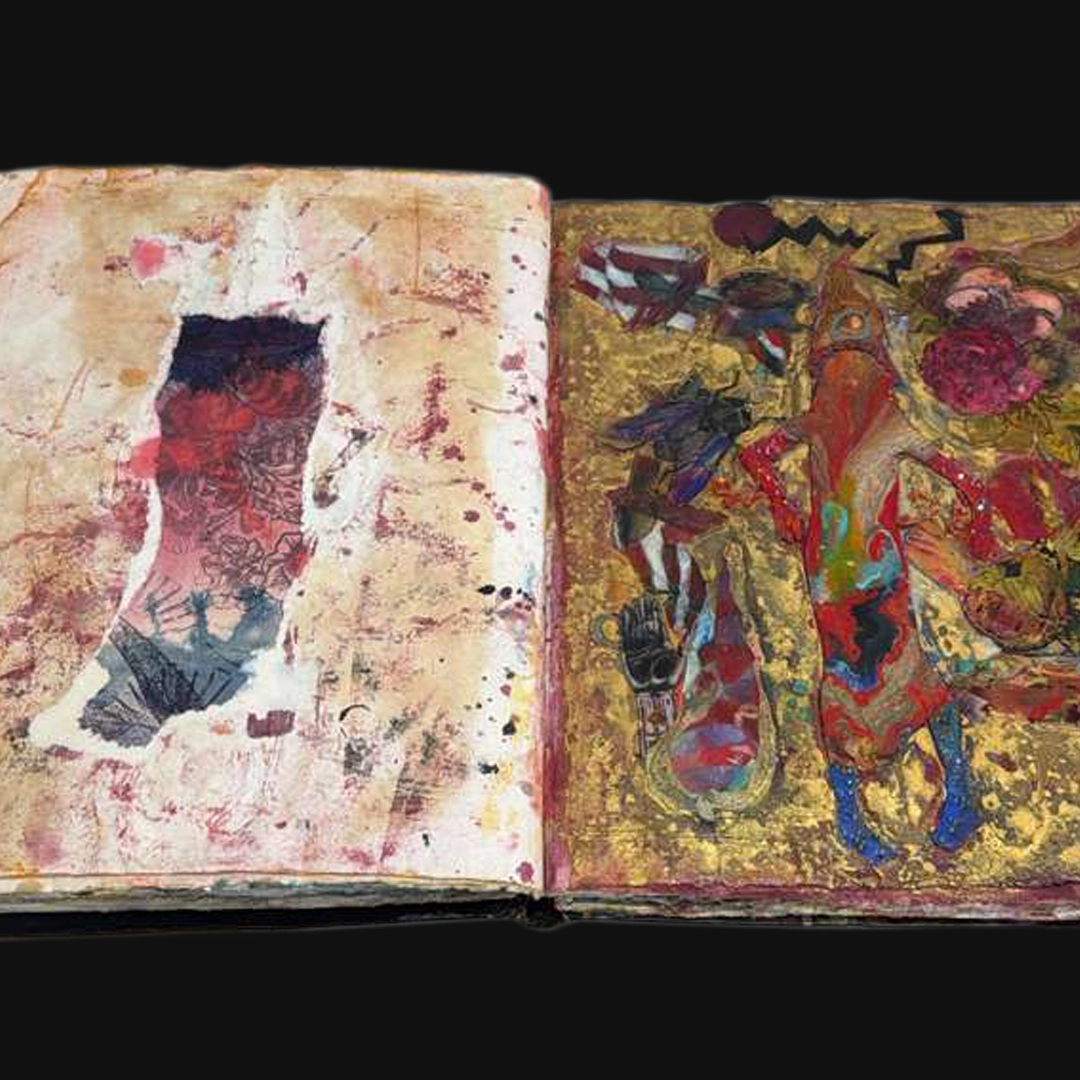
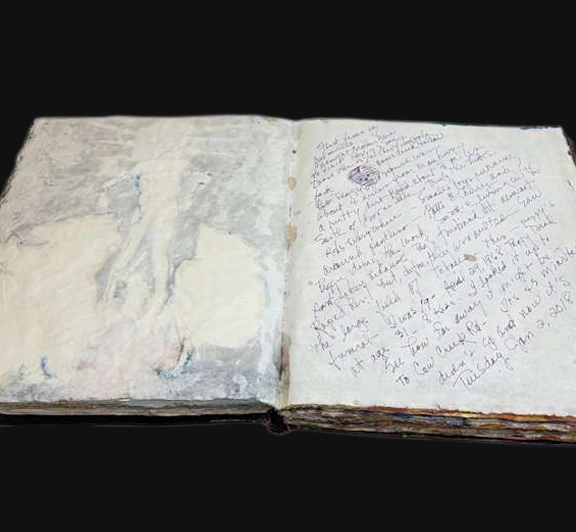
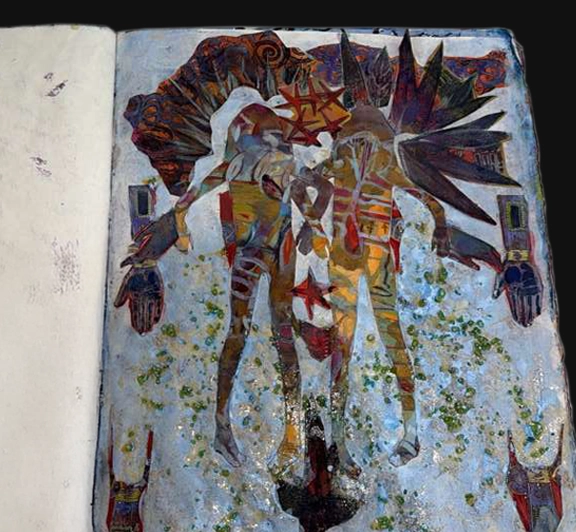
One of the most endearing works in Women of PAC is an artist’s book by Halena Cline, a piece folded into the curatorial proposal at the last minute. Not because it possessed some exceptional aesthetic value, but because it allows us to witness a narrative will: the way the final stages of her process unfold, what precedes them, and what follows from them. It can thus be read as a kind of diary spanning nine years of work, from May 10, 2017 to the present. There is a paradox in the fact that this exhibition interrupts it in order to share its more or less private contents for roughly a month.
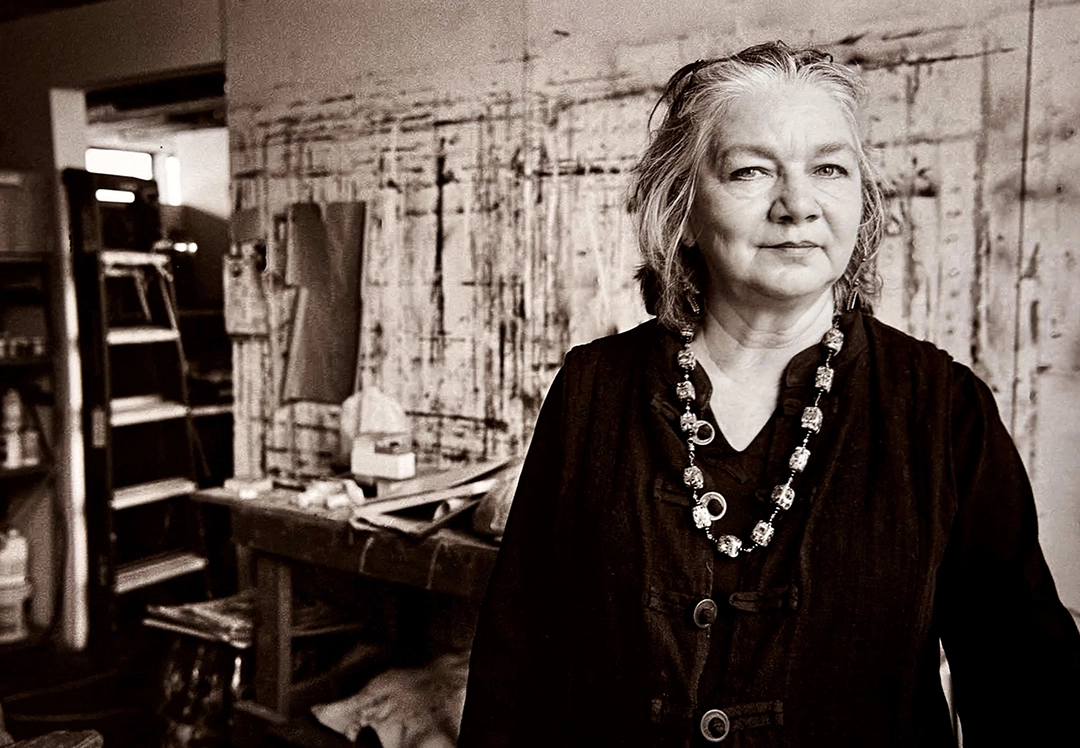
Based in Northern Kentucky, Halena Cline has sustained a studio practice over decades from her workspace at the Pendleton Art Center in Cincinnati, where she has worked continuously since 1990. Her work, widely recognized across the United States and held in collections both nationally and abroad, inhabits a territory where the experimental and the traditional coexist without friction, contaminating and reconfiguring one another.
That is one of the reasons Cline’s production does not answer to any single stylistic allegiance. Her work is structured through a logic of accumulation and transformation. References to movements such as Dadaism, Fauvism, and Surrealism converge within it, articulating a hybrid visuality that refuses membership in any fixed school. It is perhaps in this condition of stylistic crossbreeding that the core of her project begins to reveal itself.
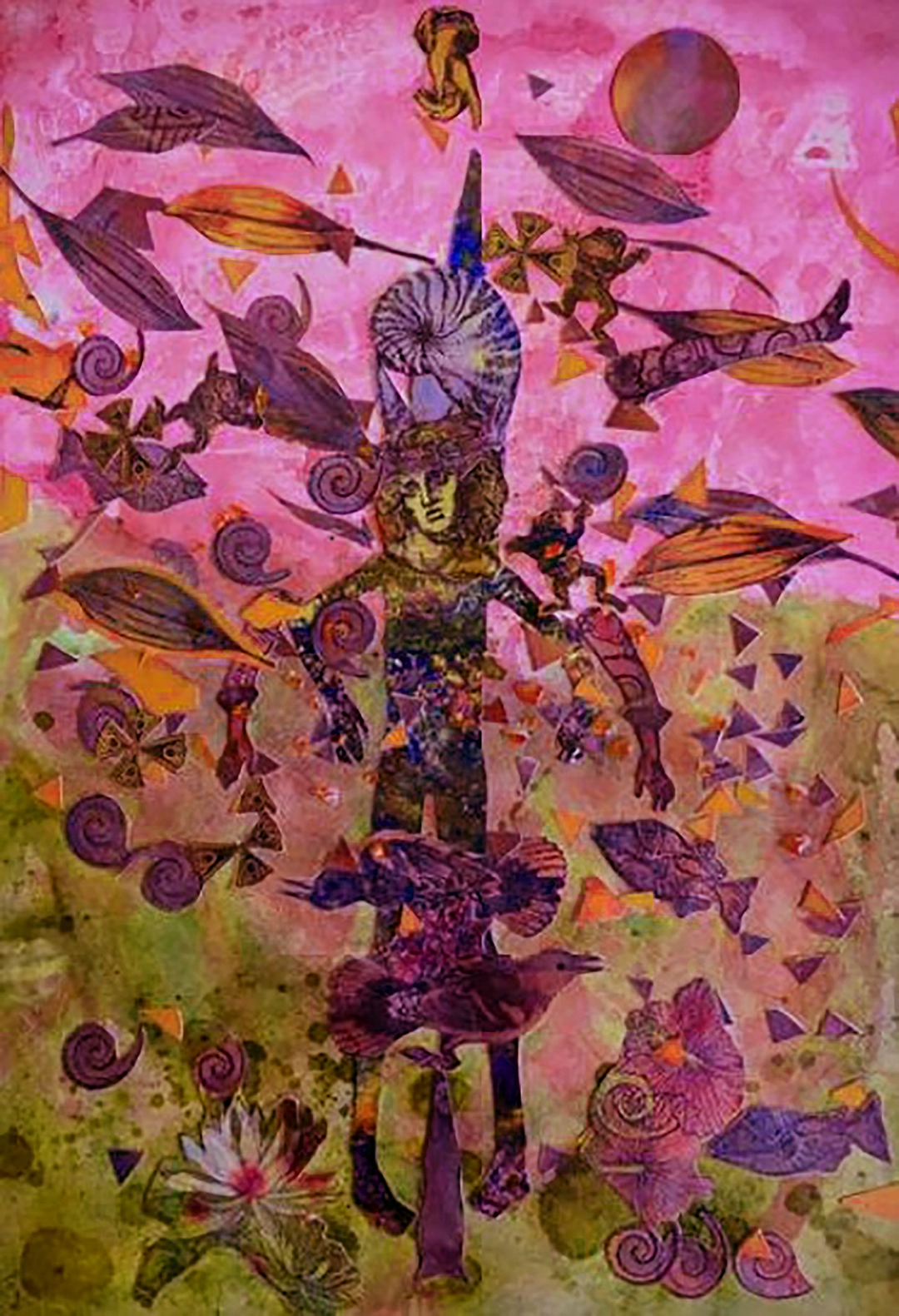
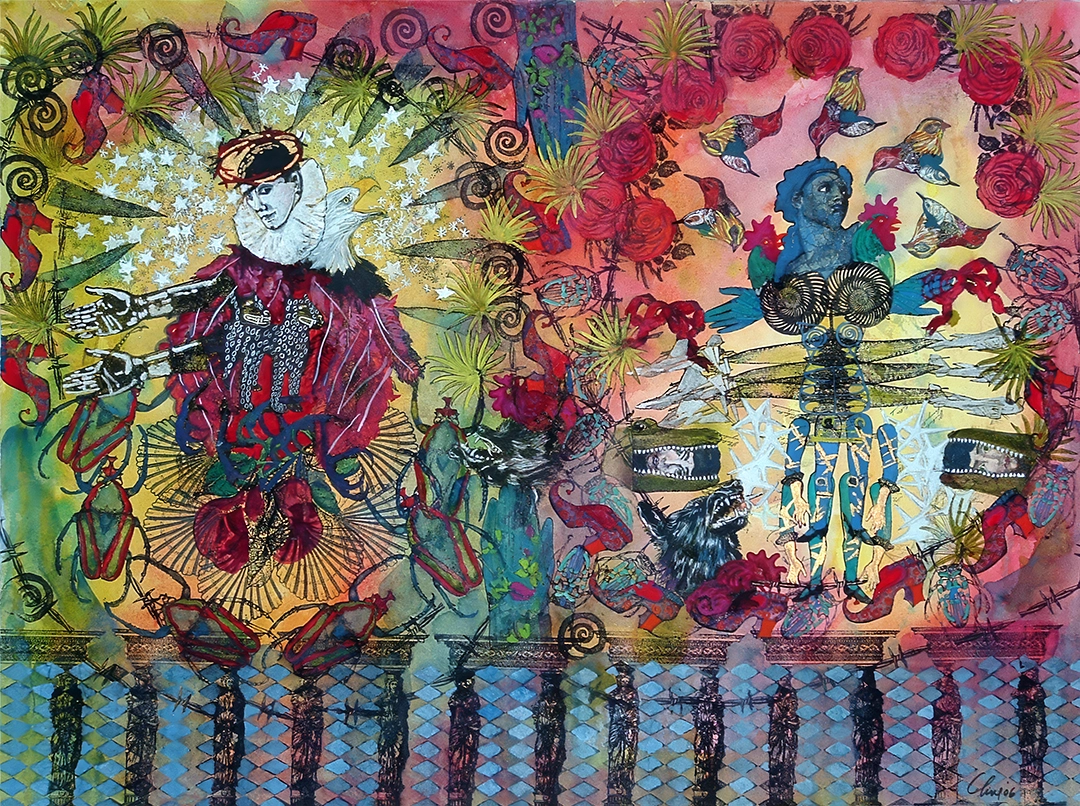
In a body of painting built out of experience, memory, and the need to speak, the figurative and the abstract intertwine in scenes that, though at first glance dreamlike or even playful, disclose tensions common to any act of creation. The figures—often fragmented, displaced, or suspended bodies—inhabit ambiguous spaces where the psychological assumes a determining weight. In works such as Merging Spheres, the simultaneous presence of the masculine and the feminine within separate yet interdependent atmospheres suggests a field of forces in which the emotional, the symbolic, and the subconscious are fused together.
A particularly significant line within her work is the one that turns toward childhood. Across several series, the figure of the young girl appears as both visual and conceptual axis. Strikingly, far from representing innocence, she appears in awkward, tense, even vulnerable postures. Cline constructs these silhouettes from painted papers—structures that evoke mannequins or dressmaker’s forms—along with elements such as barbed wire or suspended fruit. Her narrative becomes complex by holding all this figuration on a single plane of value. Precisely because they are indissoluble, the domestic, the social, and the psychological produce a shared resonance that activates a critical reading of fragility when exposed to the implacable judgment of contemporary society.
Cline’s commitment to issues touching on childhood, women, and society’s most vulnerable sectors is not confined to the content of her work; it also extends into her pedagogical labor. Convinced of the essential role of art in education, she has participated in numerous academic forums and lectures at institutions such as Northern Kentucky University, the University of Cincinnati, the Contemporary Art Center, and the Taft Museum in Cincinnati.
Her life trajectory—marked by intense experiences, displacements, and processes of personal reconstruction—runs directly through her production without cheapening itself into literal narrative. Instead, it becomes an insistence on exploring the margins of human experience: fear, memory, desire, and contradiction. Its power lies in remaining open, on the threshold of the question, within that unstable field where, as one of the ideas that traverses her imagination suggests, creation emerges from the tension between what we are and what we believe ourselves to be.
Halena Cline inhabits a territory of constant negotiation among form, experience, and consciousness: a space where her poetics, nourished by memory and direct experience, sustains itself in a continuous dynamic of tension and transformation.
Images in Sequential Order
Artist’s Book
Photograph of the artist
Autumn Breeze, 2020
Watercolor and Ink on Artistica acid-free Paper | 25½ x 19¾ in
Merging Spheres II, 2006
Watercolor and Ink on Artistica acid-free Paper | 36¾ x 25½ in
