


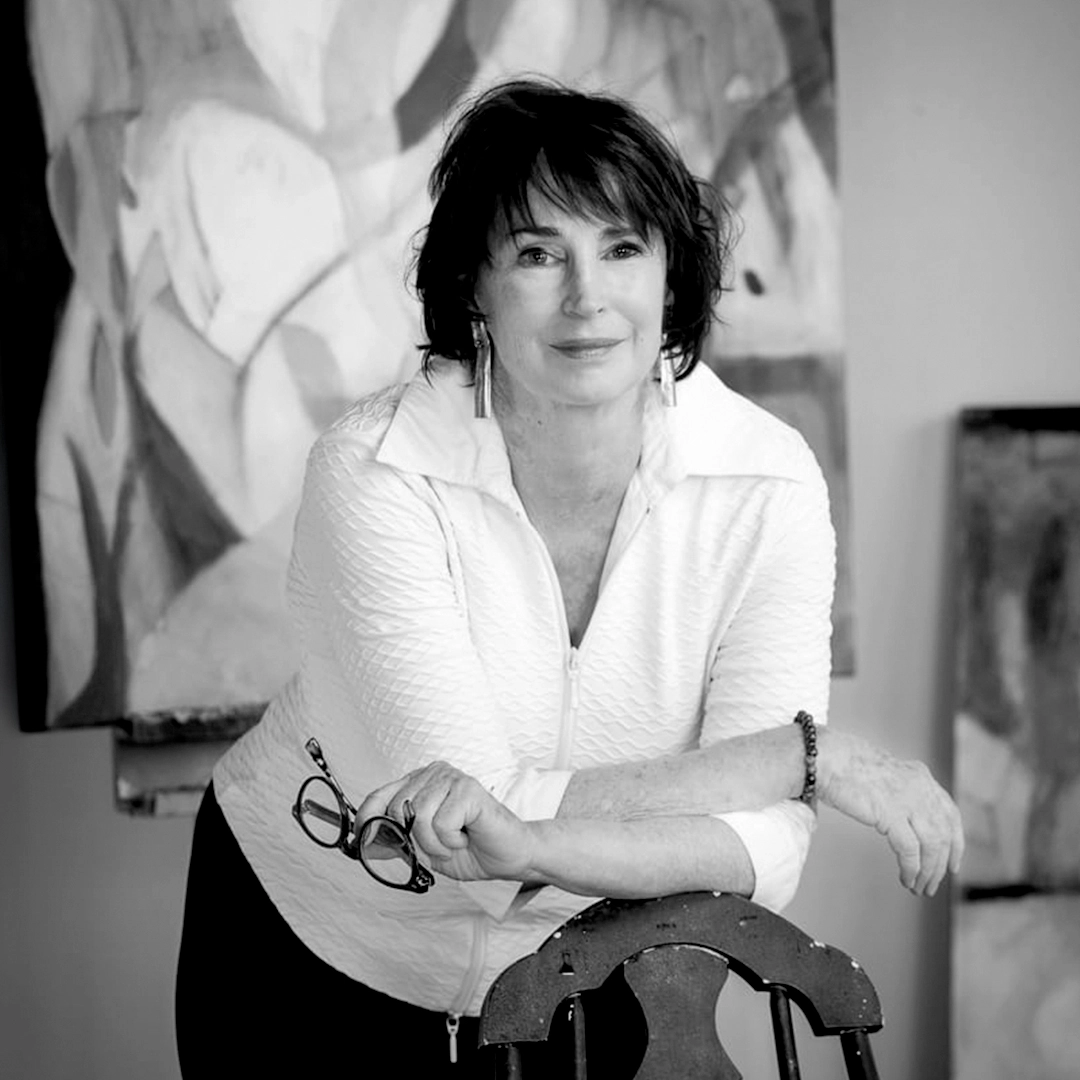
M. Paula Wiggins has built a long and varied practice through painting, drawing, collage, and illustration. Her work brings together abstraction and figuration, often through vivid color, layered surfaces, and an ongoing interest in symbol, humor, people, and the visible and invisible dimensions of experience. Across decades, she has moved between commissioned work and studio practice while continuing to develop a personal visual language grounded in experimentation and change.
Paula began her studies at DAAP, University of Cincinnati, as a painting major with a minor in film. She later returned to school at the Art Academy of Cincinnati for several years to study illustration. That formation opened a broad professional path. Over time, she produced work for magazines, newsletters, CD covers, calendars, posters, and other printed formats, while continuing to paint and draw. In 2000, she was part of a group of artists who exhibited in Germany. Around 2005, she changed her style toward abstraction.
Art and music have long been central to her life. She recalls an eighth-grade teacher, Sister Thomas Aquinas, who played music during art class and encouraged students to paint to what they heard and felt. Saint-Saëns’s Danse Macabre was one of the pieces that stayed with her. In her own words, art and music have always been her great loves. She has described art as “a drop of happiness and hope in our lives” and as “a window of insight into a purely imaginary realm that barely touches reality.” That idea offers an important key to her work, which moves freely between observation, imagination, and emotional association.
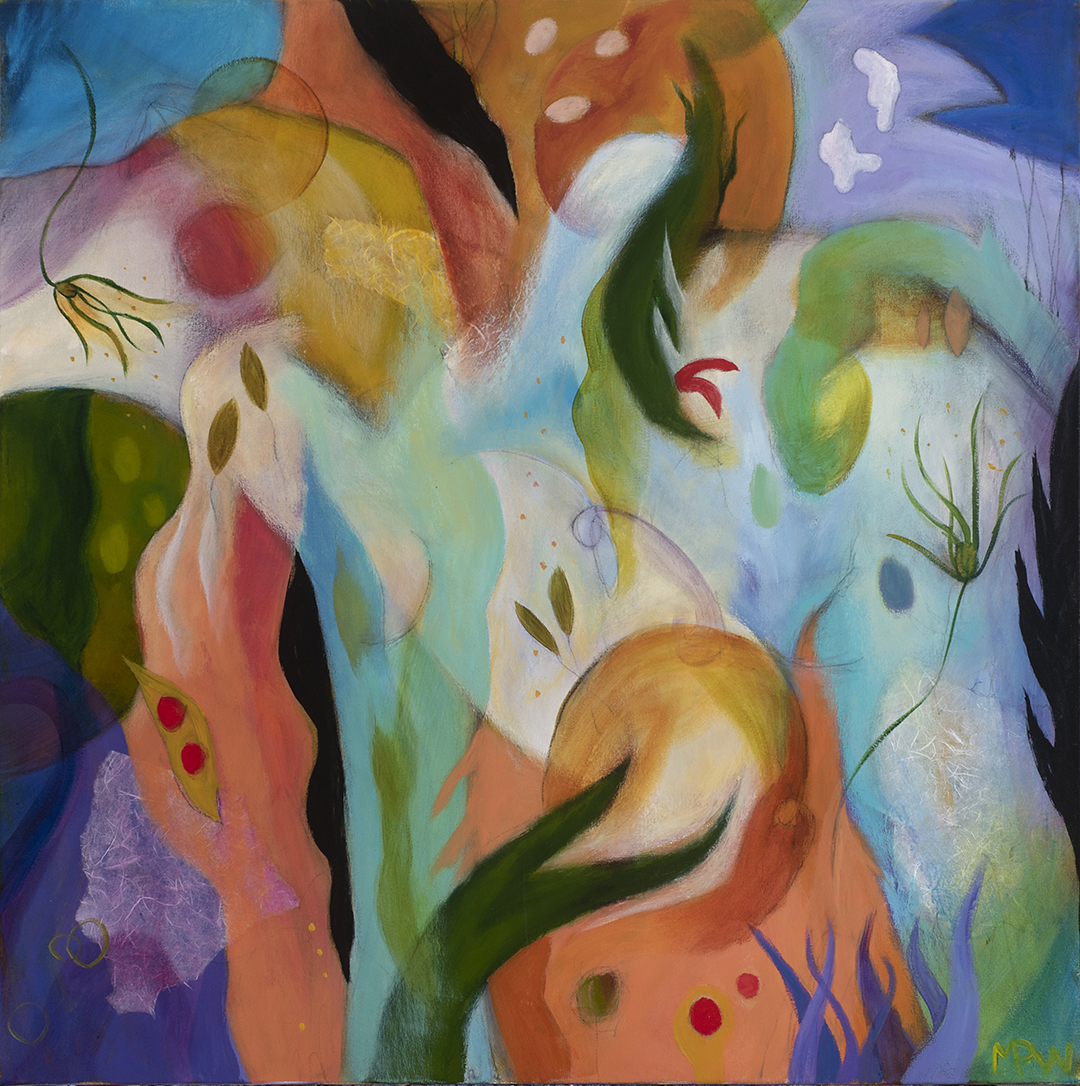
Wiggins has described her work in direct terms: “My work is about color, symbol, humor, people, the rational mind, the irrational mind, the world we see, the world we don’t.” That statement helps clarify the range of elements that appear in her practice. Her paintings often bring these concerns together through compositions that remain open to multiple readings. Color plays a particularly strong role in that process. Her palette is frequently bright and bold, and her use of color appears intended to provoke an immediate emotional response.
A significant aspect of her current practice is her decision to paint over old canvases. This process allows her to develop new ideas while maintaining a connection to earlier work. It also gives her surfaces a layered quality that reflects continuity within her artistic life. In this sense, the act of reworking older material can be understood as part of an ongoing conversation with her own past production.
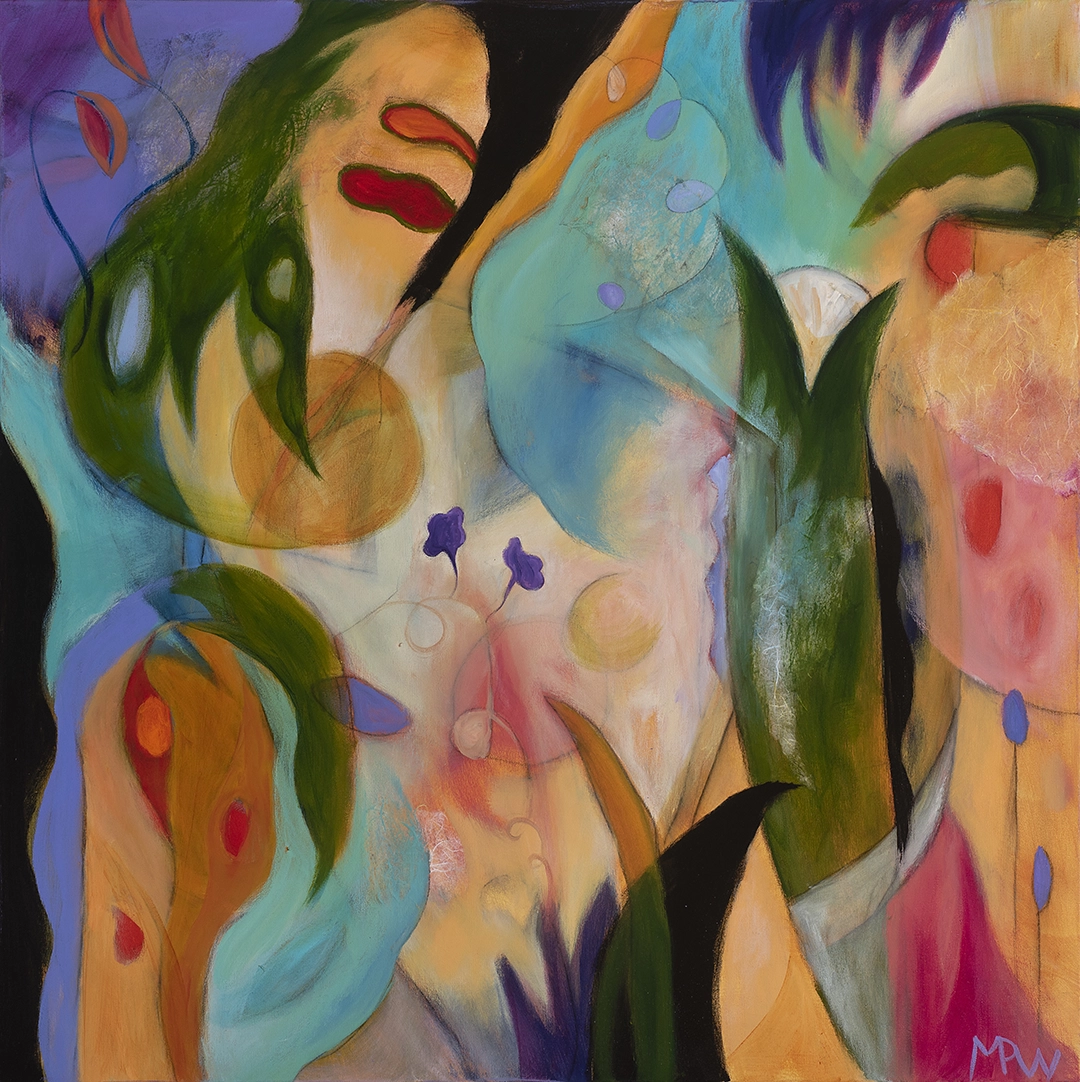
That logic of layering is present more broadly in the way Wiggins builds a canvas. Painting, for her, may include paper, found objects, paint, charcoal, additional paint, and varnish. Some descriptions of her work also point to the use of musical notation, parts of scores, printed newspaper material, and letters of the alphabet within collage-based compositions. These materials contribute to a visual field in which image, fragment, and structure remain in close relation.
Being both a painter and an illustrator gave Wiggins the opportunity to work across many different worlds. She collaborated with publishers and art directors and created images for magazines, books, posters, calendars, and CD covers. For seven years, she also ran the stock illustration site TheSpiritSource.com, which provided images from a large group of artists for the publishing trade. Alongside that professional activity, painting remained central to her studio life.
Her formal education continued beyond her BFA from the University of Cincinnati. She also studied at the Art Academy of Cincinnati, attended the Arrowmont School of Arts and Crafts, and worked at the Fine Arts Work Center in Provincetown, Massachusetts. That continued formation suggests an artist committed to sustaining and expanding her practice over time.
One critical description included in the material presents her work as dealing “more abstractedly with personal experience,” in compositions that mirror the mind’s selection through memory. It also notes her use of musical notation, newspaper fragments, and alphabetic structures, together with brilliant reds, purples, and greens that suggest emotional states. This reading is useful because it places memory, structure, and emotion at the center of her work without reducing it to literal narrative.
Wiggins has also expressed a clear conviction about the role of the personal in art: “If the personal in art does not touch the universal, it is narcissism. Inward directed art should reach a spirit that links it to a wider being.” That statement gives important context to her practice. However personal its sources may be, her work aims toward connection and shared resonance.
There are now efforts to document Wiggins visually in her studio, and that context seems especially relevant in relation to her process. Such documentation can offer viewers a better understanding of the environment in which the work develops and of the materials, revisions, and ongoing decisions that shape it. In her case, the studio is also the place where older and newer surfaces meet, where works in progress remain open, and where process becomes visible.
M. Paula Wiggins has developed a body of work shaped by painting, illustration, experimentation, and sustained revision. Her practice brings together abstraction and figuration through color, layering, and a strong investment in image-making as a space for thought, feeling, and transformation. Seen across time, her work reflects both continuity and change, and remains open to the many worlds she has moved through as an artist.
Images in Sequential Order
Photograph of the artist
Delighted Jungle, Undated
Acrylic on canvas | 36 x 36 in
Juicy Jungle, Undated
Acrylic on canvas | 36 x 36 in

