


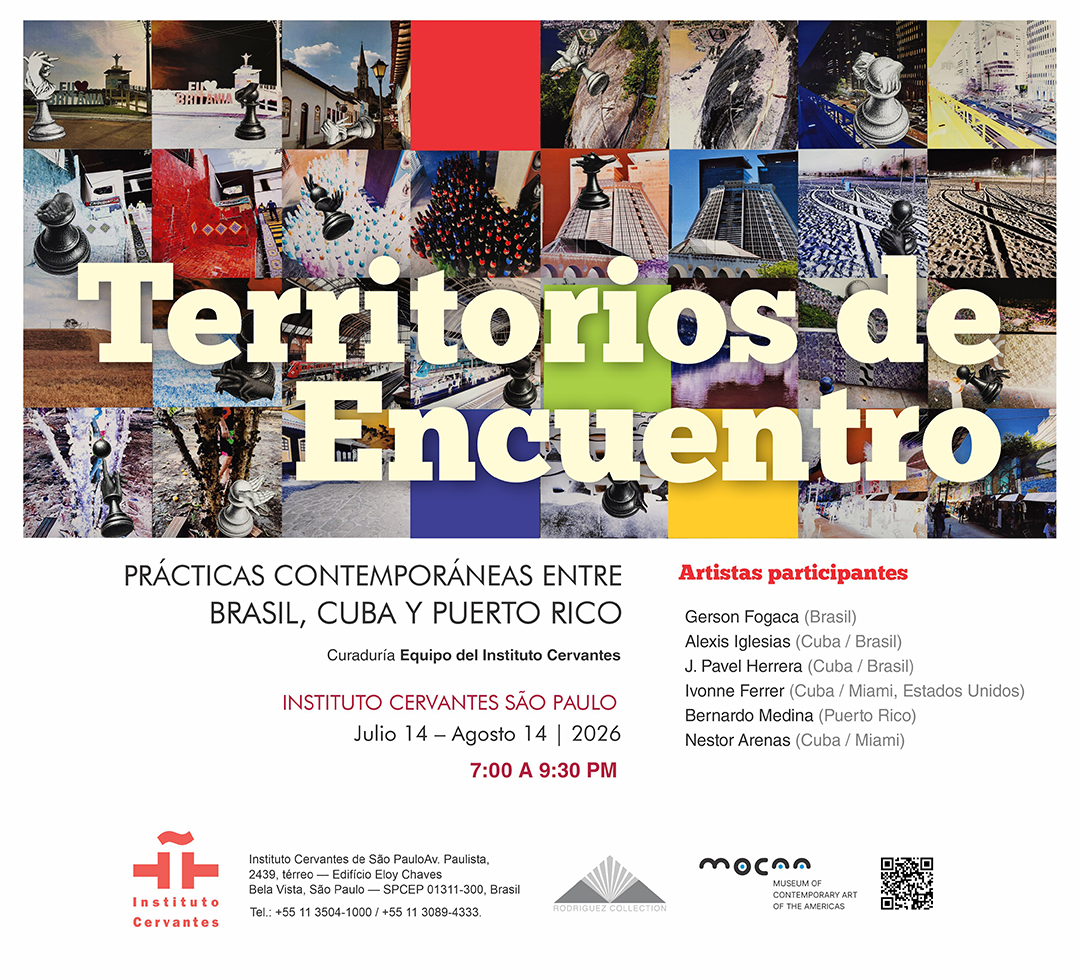
From July 14 to August 14, 2026, the Instituto Cervantes of São Paulo presents Territorios de Encuentro. Prácticas contemporáneas entre Brasil, Cuba y Puerto Rico, a group exhibition that the Museum of Contemporary Art of the Americas (MoCAA) advances together with the Rodríguez Collection as part of its international curatorial initiatives. Curated by the Instituto Cervantes team, the exhibition may be visited from 7:00 to 9:30 p.m. at the institution's premises, on Avenida Paulista 2439, ground floor of the Edifício Eloy Chaves, Bela Vista (CEP 01311-300).
The exhibition gathers six artists whose trajectories cross Brazil, Cuba, Puerto Rico, and the United States. Taking part are the Brazilian Gerson Fogaca; the Cuban artists based in Brazil Alexis Iglesias and J. Pavel Herrera; the Puerto Rican Bernardo Medina; and the Cuban artists living in Miami Ivonne Ferrer and Nestor Arenas. The project regards Brazil, Cuba, and Puerto Rico as spaces in constant cultural, historical, and symbolic exchange, bound together by the sea, by migration, and by the processes of mestizaje that shaped the Caribbean and Latin America. To that fabric it adds Miami as a contemporary territory of encounter, where many diasporas converge and where identities continue to be negotiated.
Each artist embodies a distinct way of inhabiting that transit, from the root to migration, from permanence to transformation, from the memory of one's place of origin to the reinvention of identity within new cultural contexts. Rather than a unified narrative, the project takes multiplicity as its very structure, and each work operates as a node within a wider network of shared experiences, where bodies, materials, and visual languages reveal the visible and invisible traces of those crossings.
Territorios de Encuentro affirms one of MoCAA's most sustained lines of work, that of carrying the South Florida artists tied to its collection toward international stages of genuine cultural standing. On this occasion, the Miami voices are those of Ivonne Ferrer and Nestor Arenas, two Cuban artists settled in South Florida whose work now travels to one of São Paulo's principal cultural avenues. The gesture extends a program of two-way exchange among Brazil, the Caribbean, and the United States, through which artists from the museum's collection appear in Brazilian institutions while Brazilian artists are invited to Miami to exhibit and to lead educational activities. The Instituto Cervantes of São Paulo had already hosted Cuban Art from Both Shores, advanced by MoCAA together with the Rodríguez Collection.
From July 14, on the ground floor of the Edifício Eloy Chaves, along Avenida Paulista, the works of the six artists will hold open that bridge from one shore of the Atlantic to the other, each evening until half past nine.

