


Few exhibitions of recent years have achieved the kind of resonance that Caminhos de Terra e Vento has generated throughout Brazil. Following its inauguration at Vila Cultural Cora Coralina in Goiânia, the project—organized by the Urukum Institute in partnership with the Museum of Contemporary Art of the Americas (MOCAA), Miami—captured the attention of major media outlets, art platforms, and government channels across Goiás and beyond. More than twenty publications, from O Popular and Diário do Estado to O Mundo Diplomático, Correio da Manhã, and Revista Zelo, echoed the event’s significance as a landmark of cultural exchange between Brazil and the United States.
The breadth of this coverage reveals not only the exhibition’s local success but the symbolic recognition of Miami’s contemporary art institutions within Latin America’s cultural dialogue. News agencies, lifestyle magazines, and institutional portals—such as Aproveite a Cidade, Política em Goiás, Portal Expressão, and the official page of the Government of Goiás—described the collaboration as a “meeting between Miami and Goiás,” emphasizing the vitality of the partnership and its role in expanding access to Latin American art histories. The tone of these reports went beyond mere event promotion: they positioned the exhibition as a diplomatic and artistic gesture capable of connecting territories and sensibilities through art.
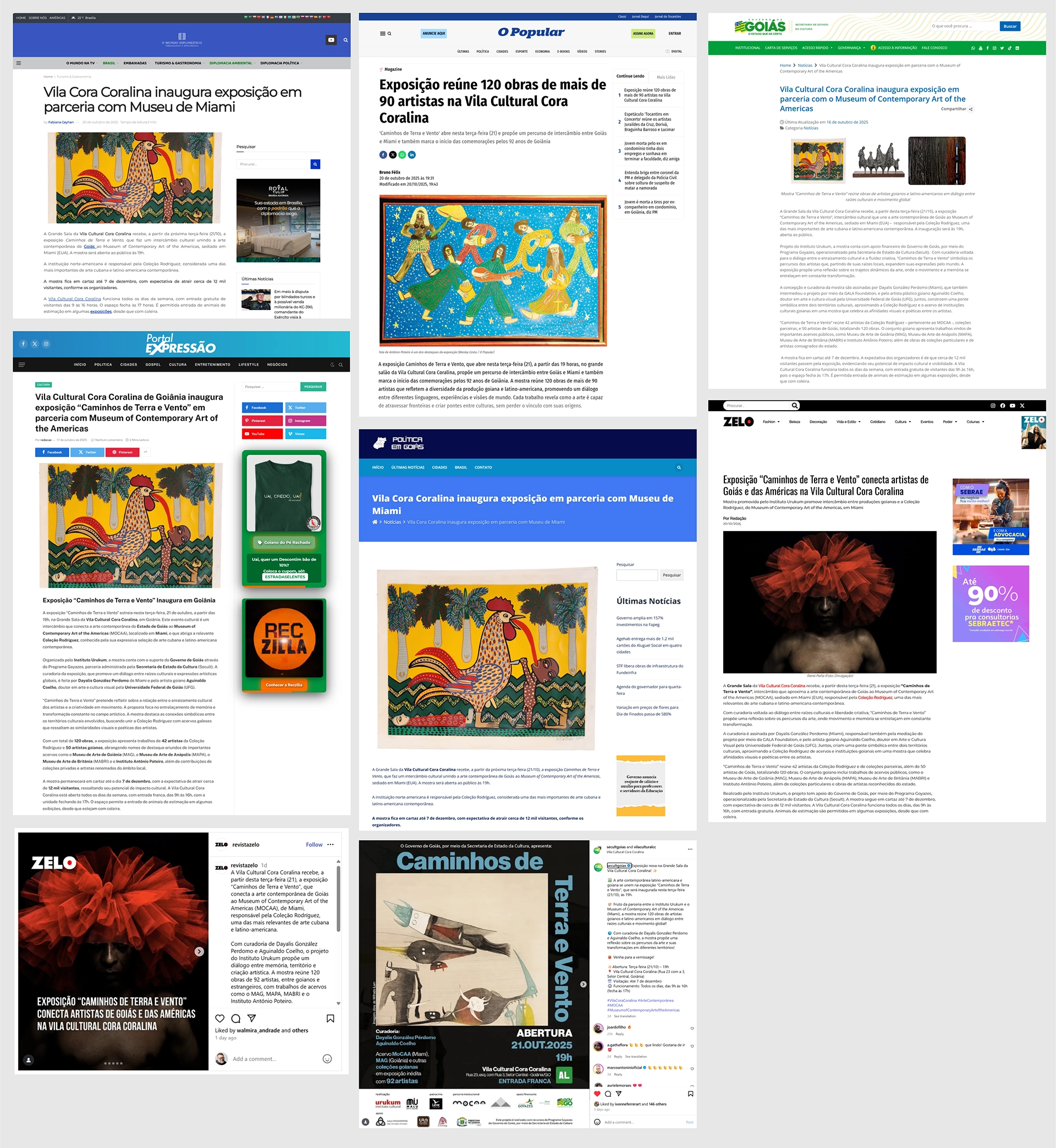
For the South Florida art community, this moment marks an invaluable affirmation. The visibility achieved by Caminhos de Terra e Vento across Brazilian media underscores Miami’s evolving role as a continental hub—no longer perceived solely as an importer of Latin American art, but as an active interlocutor within it. By bridging Goiás’s modern and contemporary traditions with the Rodríguez Collection’s archives at MOCAA, the collaboration projected Miami as a space of exchange, curatorial experimentation, and cultural reciprocity.
Press outlets across Goiás highlighted the exhibition’s scale—120 works by 92 artists—and its expected reach of over twelve thousand visitors, but also celebrated the intellectual framework that defined it: a meditation on roots, movement, and transformation. In this sense, the media’s enthusiasm mirrors the exhibition’s conceptual ambition. The stories published in both print and digital platforms adopted the language of dialogue and belonging, suggesting that the aesthetic bridges between Miami and central Brazil speak to a larger redefinition of Latin American cultural geography.
The impact of this collective attention extends beyond the immediate success of the show. It affirms the importance of transnational collaborations for regional art ecosystems—particularly for Miami, whose institutions thrive on their ability to sustain conversations that cross borders, languages, and artistic genealogies. Each mention in the Brazilian press, each headline describing the “encounter between Miami and Goiás,” contributes to reinforcing South Florida’s image as a cultural territory in permanent dialogue with its southern counterparts.
In the end, what reverberated through Brazilian media was not only the opening of an exhibition but the consolidation of a vision: that art can be both local and transcontinental, rooted and migratory, intimate and expansive. Through the words of Brazil’s journalists and cultural commentators, Caminhos de Terra e Vento became more than an event—it became a message. A reminder that the winds of artistic exchange continue to carry the voices of the Americas, from Goiânia to Miami, and beyond.

