


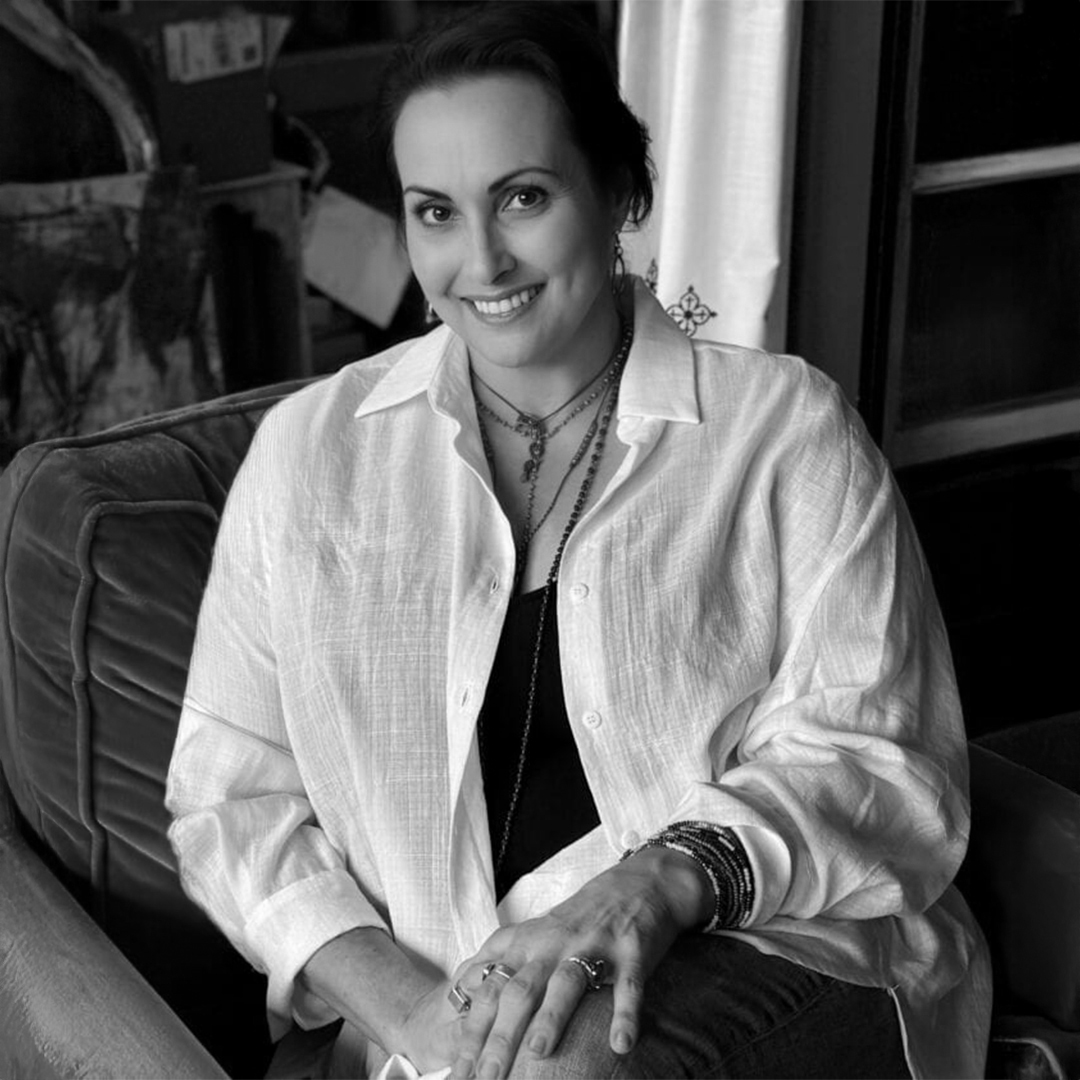
In its most recent winter exhibition, Women of the PAC, the Museum of Contemporary Art of the Americas (MoCAA) also presented the work of Tracy Casagrande Clancy, an artist based in Cincinnati, Ohio, whose mixed-media practice unfolds a rare sensitivity—one shaped by an engagement with pain as lived territory, understood and worked through attentive listening.
Casagrande Clancy has developed a body of work that combines encaustic, photography, collage, graphite, and oil, marked by surfaces that appear eroded, stratified, almost archaeological. Her visual language constructs a slow experience in which each layer records the passage of time, loss, memory, and what remains when everything else shifts. According to her own statement, her work begins from the conviction that there exists an unbreakable thread connecting all forms of existence—a network of interdependence that moves across communities, cultures, and geographies, and that has the capacity to transform how we inhabit the world.
This is not a theoretical abstraction. For years, before fully dedicating herself to art, Casagrande Clancy worked as a pediatric and family grief therapist, accompanying children and families through situations of extreme loss. Her professional experience extended into critical areas including neonatal and pediatric intensive care, trauma, HIV/AIDS, disaster relief, and support for individuals experiencing homelessness. This direct contact with vulnerability—real, not metaphorical fragility—grounds the ethical dimension of her artistic production.
In the present moment, where isolation and polarization have become normalized as ways of living, Casagrande Clancy’s work operates as a counter-gesture, insisting that the individual does not exist in a pure, isolated, self-sufficient state. Her practice proposes that identity is always relational, a system of constant exchange between what we give and what we receive. At this point, the artist introduces a spiritual dimension—“the Divine, by whatever name one chooses to give it”—as the force that reveals the essential connection between beings.
Her images, often marked by a recurring iconography of shelter, anatomy, and the human figure, do not describe specific scenes so much as they articulate states, bonds, ruptures, and emotional displacements. These are works that withdraw from elementary narrative and instead suggest. Within them, matter does not merely represent—it retains memory. Every abrasion, every lifted layer, every transparency seems to affirm that nothing fully disappears; it changes form.
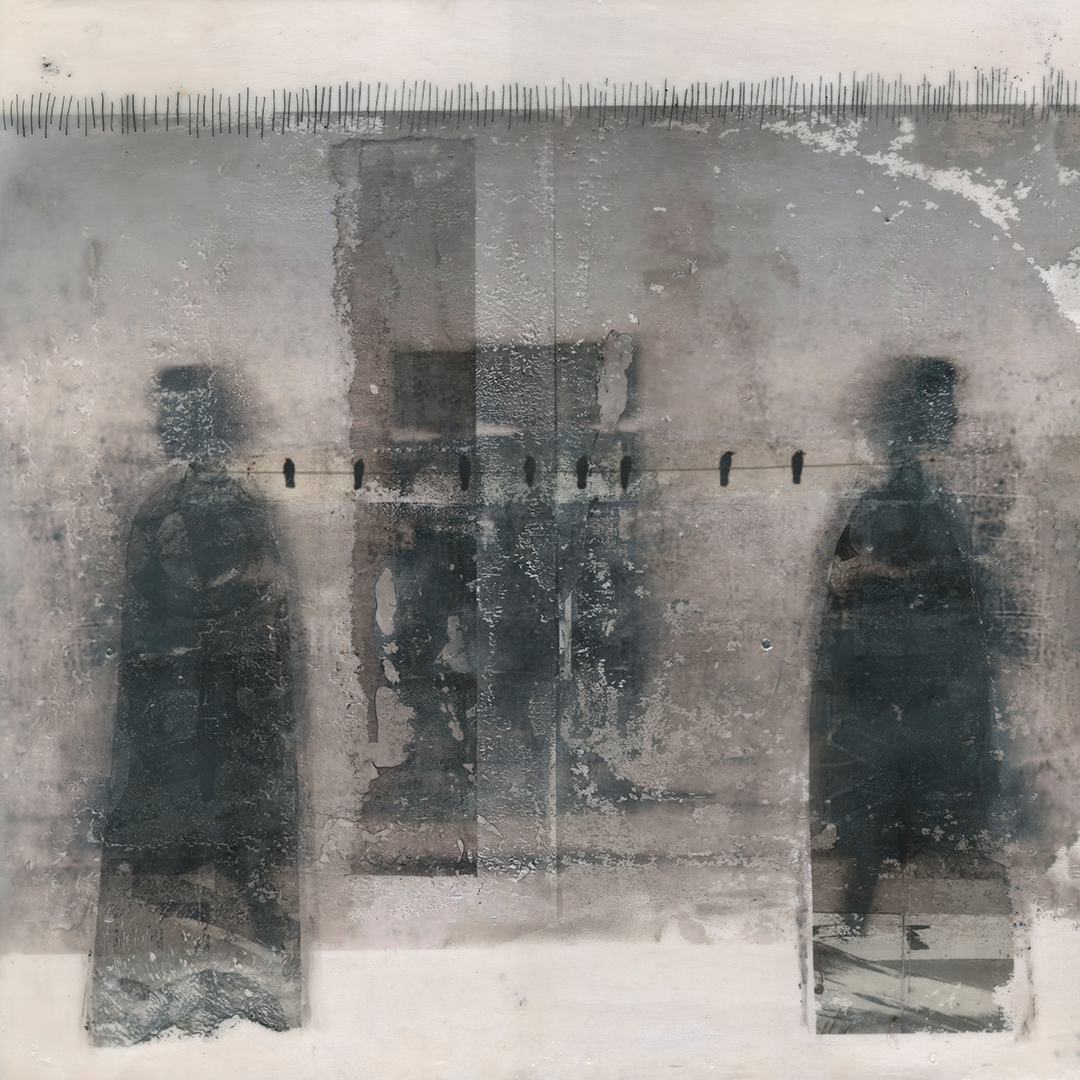
Those of Other Fates
Within Women of the PAC, Those of Other Fates stands out—a piece composed of encaustic, oil, graphite, original photography, and collage on birch panel, measuring 24 × 24 inches.
The text accompanying the work begins with an intimate and universal question: what happened to that person? Why does someone cease to remain in our life? What binds us at a precise moment, and what separates us afterward? Is it choice, fate, coincidence? Casagrande Clancy does not attempt to resolve the dilemma. She translates it into image.
The piece proposes a contained scene of separation. Two shadowed figures move in opposite directions, softened by an atmosphere that seems made of distance, erosion, and memory. They are not portraits; they are presences. Between them extends a thin horizontal line, crossed by small, watchful birds—silent witnesses to a brief intersection that may have altered more than its participants could understand at the time. The surface, deliberately deteriorated and layered, suggests the passage of time as erosion—not only physical, but affective.
There is also a vertical division, a faint seam that separates the figures and something deeper—the possibility of encounter again. With this gesture, the artist introduces decisive nuance: two complementary destinies and the internal fracture that every experience leaves behind.
Those of Other Fates speaks of loss without dramatization and of memory without nostalgia. Its tone carries a quiet unease. It proposes that many relationships exist only to fulfill a brief function—to teach something essential, to alter our direction—before disappearing. The work suggests that even fleeting encounters may be structural, as though certain people are necessary not to remain, but to activate change.
Women of PAC: visibility, presence, and discourse
Women of PAC consolidates a space that articulates a map of diverse contemporary practices, where individual experience intersects with the social, the political, and the spiritual.
Within this framework, Tracy Casagrande Clancy contributes a singular voice. Her work rests on a sensitive inquiry into what it means to remain connected, even in separation. It insists that life is relation, and that this network—at times loving, at times painful—forms the true fabric of the human.
From her studio on the eighth floor of the Pendleton Arts Center in Cincinnati, where she works and leads international workshops in encaustic and mixed media, Casagrande Clancy continues to build a coherent and expanding body of work with global reach, already present in private, corporate, and public collections, including the permanent collection of the Museum of Encaustic Art in Santa Fe.

